


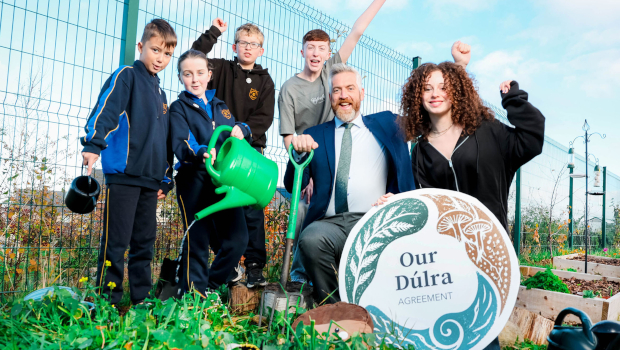
Education Support Centres, Education and Training Boards, patron bodies, management bodies and educational trusts have committed to a biodiversity pledge modelled on the UN Conference of the Parties (COP).
Our Dúlra Agreement has grown out of the Irish Schools Sustainability Network (ISSN), a community of teachers volunteering their time to change the system from within. It is supported by a steering committee and driven in practice by the Biodiversity Working Group for Schools, comprising Biodiversity in Schools, Education Support Centres Ireland, Green-Schools, ISSN, Learning About Forests and Ecosystem, and the National Biodiversity Data Centre.
The Agreement was introduced in June 2026, when the Biodiversity Working Group for Schools brought education system leaders together at Wildacres, a 17.5 acre nature reserve on the Redcross River in Co. Wicklow, to co-create a strategy for putting it into practice

The Agreement was initially signed by 18 Education Support Centres from around Ireland, as well as Accelerating Change Together (ACT), Global Action Plan Ireland, the Irish Forest Schools Association, and the National Association of Principals & Deputy Principals.
While schools across Ireland mainly rely on a small number of teachers to promote biodiversity efforts, Our Dúlra Agreement calls on the wider education system to take responsibility for supporting biodiversity and ensuring it becomes part of the whole school community.
Research has highlighted the benefits of nature for children’s learning and wellbeing. A study of more than 2,500 schoolchildren in Spain found that those in greener schools made bigger gains in working memory and attention over a year. A Danish study of almost one million people found that children who grew up with the least green space had up to a 55% higher risk of developing a mental health disorder later in life.
This autumn, six Education Support Centres in Limerick, Dublin West, Cork, Donegal, Laois and Waterford are hosting Whole-School Biodiversity Train-the-Trainer days. Schools are asked to send a principal or deputy principal alongside a member of staff, ensuring leadership is part of the process. Each school leaves ready to train its whole staff, with the start of its own Dúlra plan mapped on its grounds.
Dr Patrick Kirwan, founding director of the Irish Schools Sustainability Network (ISSN), said: “Many of us left school without ever being taught to love and respect nature, and to understand that every part of our lives depends on it. It’s time to break that cycle. Schools take their cue from the people who lead them, and when education system leaders sign this Agreement, they get behind the great work already happening in schools across Ireland, so that every child grows up with that connection, not just the lucky few.”
Minister of State for Nature, Heritage and Biodiversity Christopher O’Sullivan, said: “When education leaders came together at Wildacres in June to shape this Agreement, I said their leadership was vital. Today they are putting their names to it. Ireland’s Nature Restoration Plan needs a whole-of-society response, and our schools are the soil where that restoration takes root. With this Agreement, school grounds can move beyond tarmac and mown grass to places where children watch nature come back. Last month, I joined world leaders at COP17 in Armenia to commit to speeding up efforts to protect and restore nature at a global level. Making nature restoration a living reality in every school in Ireland is an important way of honouring these international commitments at home”.
The latest signatories include Edmund Rice Schools Trust, Educate Together, Kilkenny, Le Chéile Schools Trust, IrishWaldorf Education Association, Dublin West Education Support Centre, and Education and Training Boards in Galway Roscommon, Dunlaoghaire, and Cork.
TechCentral Reporters

 Ltd