


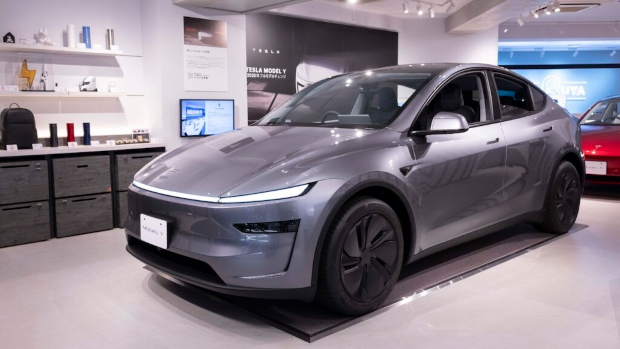
On 15 December while most of us are knee-deep in Christmas shopping a committee of national vehicle experts in Brussels might finally vote on whether Tesla’s driver-assistance software can be switched on across the European Union.
A draft agenda published by the European Commission this week says the Dutch request will be examined “with possible vote”, meaning it’s the first time a vote has explicitly been put on the table after two earlier meetings (in June and October) came and went without one.
So what’s the big deal? BMW and Ford already have hands-free systems approved for European motorways. Why is this any different?

Well, until October, the software was sold as Full Self-Driving (Supervised) – a title that annoyingly contradicts itself in brackets – but following pushback from Germany’s transport ministry, Tesla rebranded it in Europe as Tesla Assisted Driving.
The Dutch vehicle authority, the RDW, which granted the first European approval in April after 18 months of testing, has already been at pains to stress it is driver assistance – not self-driving. This means it can steer, accelerate and brake but the driver has to watch the road at all times and is legally responsible: hands off, eyes on. (This is checked through a cabin camera and you get a strike if you look away during a manoeuvre).
Then there’s the issue of speed: in a letter obtained by Reuters, Sweden’s Transport Administration said the system shouldn’t be approved for EU roads unless its ability to exceed speed limits was removed. This is a feature called ‘speed offset’ that lets the driver tell the car to go faster than what is signposted. France has raised similar concerns about speeding and driver attention. Anyway, the upshot is that Tesla struck a compromise with Germany: the offset, which could previously be set as high as 50% over the limit, is now capped at 10% so… the car will only break the law a little bit.
Caution advised
What Europe is getting is a more cautious version than the one American drivers use. In the US, drivers can go hands-free with the software at any speed and new features arrive there first because nobody in the US pre-approves driver-assistance software. In Europe, an authority tests every update before it ships and can refuse it, and the car keeps a closer eye on whether the driver is actually paying attention.
The Dutch, for their part, said in June that nearly 40,000 Teslas had covered around 24 million kilometres on their roads with the software “without any relevant incidents”. I’d love to know what non-relevant incidents occurred.
Nearly a dozen countries have followed the Dutch lead with Italy to begin a rollout, but bloc-wide approval needs the backing of at least 15 of the 27 member states, and those countries must represent at least 65% of the EU population. Neither Germany nor France has approved it nationally – Germany has said it will support EU approval, while France has said it won’t authorise the system as it stands. If the EU rejects it, according to the Danish road authority, the Dutch approval would lapse after six months and every national approval based on it would be withdrawn – so it would be back to square one for Tesla.
The stakes go well beyond Europe’s roads because Tesla’s European registrations fell by more than a quarter in 2025. Elon Musk’s trillion-dollar shareholder-approved pay package needs to meet a target of 10 million active subscriptions for their self-driving software and it looks like Europe isn’t exactly shoring up their numbers.
Ireland, meanwhile, is in a curious position. The Minister of State Seán Canney signed a piece of law earlier this year that allows cars with advanced driver-assistance systems, where hands can leave the wheel in limited circumstances, to be legally used here. And in May, the Department of Transport confirmed Tesla was engaging with the National Standards Authority of Ireland.
But we’re not on the list of countries that have switched it on: Teslas here come with standard Autopilot, which covers adaptive cruise control and lane-keeping, but the fuller system that steers through towns and junctions is still waiting on approval. And come 15 December, our vote will count as one of the 15 Tesla needs even though our population barely registers in the 65% (we’re a tiny market of only around 1%).
So, what’s the big deal? Not the technology, which is an incremental step rather than a leap; the big deal is that Europe is about to make a unified decision on how far a car can be trusted to drive while a human pretends to supervise it.


 Ltd