

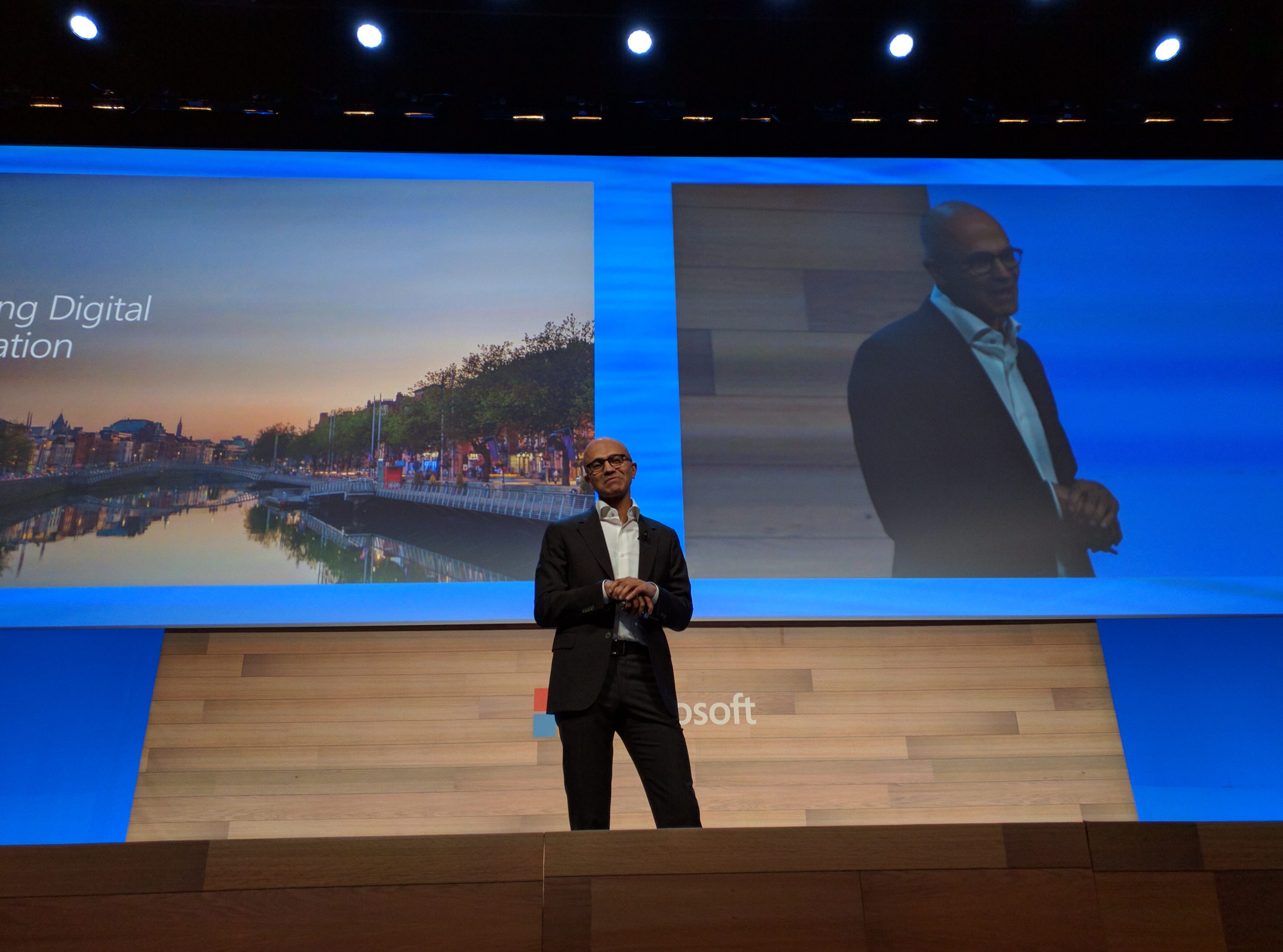
This AI supercomputer gives you, at the core infrastructure level, amazing capacity to be able to transform your applications “to the power of AI,” said Nadella.
This is done in a very open way, he added, supporting all the frameworks you want.
Also Microsoft frameworks, such as Computational Network Toolkit (CNTK), allow distributed neural networks across this fabric.
Higher layer services
Another major element of this infrastructure, Nadella said, besides the core infrastructure, is to build higher layer services to allow every developer to build intelligence into their applications.
“We believe that just like you build a web site or mobile app, every business will have a bot interface, every business process is going to have a bot interface,” Satya Nadella, CEO, Microsoft
There are, he asserted, robust information management solutions to allow you to store petabytes (PB) and exabytes (EB) of data.
Beyond that, there are highly capable services for ML at scale. There are, he said, 22 APIs exposing fundamental building blocks for intelligent applications, for example for speech, image and object recognition.
These capabilities are now available via a simple set of APIs so that every developer can use them, he said.
“We believe that just like you build a web site or mobile app, every business will have a bot interface, every business process is going to have a bot interface.”
To facilitate this, Microsoft have the Bot Framework and relevant APIs.
“These higher level intelligence services is what makes it possible for any developer out there to build these next generation applications which are driven by intelligence,” said Nadella.
Local usage
Irish organisations are already leveraging the capabilities of the Microsoft cloud.
The Health Service Executive, AIB and Cubic Telecom were singled out as examples.
The HSE is investing in the creation of a digital fabric to build a better health service and increased patient safety, said Microsoft. The eHealth Ireland initiative will create a secure cloud infrastructure using Microsoft Azure, Office 365 and Dynamics 365 and will allow a single unique identifier for all patients, single electronic health records for all mothers and babies in Ireland, a single national lab system, digital identity for health workers across the system, and communications tools to enable relationships between clinicians and patients to develop in real time.
AIB Mobile Banking, on Azure, gets 17 million hits a month and this is increasing on average by 2 million every month since it was launched. This evolution of the use of technology in banking services, said Microsoft, is ensuring that AIB is continuously looking to be a step ahead when it comes to providing the best digital option for their customers. The bank is relying on cloud services to provide these latest services. AIB is partnering with Microsoft to help them drive competitive advantage adopting the Next Generation Workplace and Next Generation Enterprise, which will optimise Customer engagements and Interactions, streamlining operations, employee productivity and engagement.
Cubic Telecom is an Irish ISV that delivers connectivity solutions in four market verticals; IoT, starting with its automotive solution; PC OEM; enterprise and branded retail. The company enables players in those four verticals, said Microsoft, to intelligently connect, manage and monetise their devices on a global basis leveraging the benefits from IoT. It partners with companies such as Audi for the Audi Connect services which will roll out across the entire Audi/VW group as well as other car brands in the near future. The company’s connectivity solutions leverage the scale and coverage of the Azure cloud to enable its own connectivity services.
Global benefit
Microsoft said it was important to have as many people as possible benefit from “the wave of innovation being unleashed by cloud computing,” ensuring that “nobody gets left behind”.
Nadella said that as a contribution to this important debate the company was releasing a book entitled “A Cloud for Global Good,” which details 78 public policy recommendations in 15 categories to help make cloud technologies more trusted, responsible and inclusive.
Topics include next-generation skills, enhancing security and privacy in the digital age, environmental sustainability, keeping communities safe, and securing a bright future for all our children. The book’s specific proposals tackle challenges like data flow disruptions that can interrupt critical services, protecting people from online exploitation and fraud, and ensuring those with disabilities can access e-government services.
TechCentral Reporters



 Ltd
Ltd