


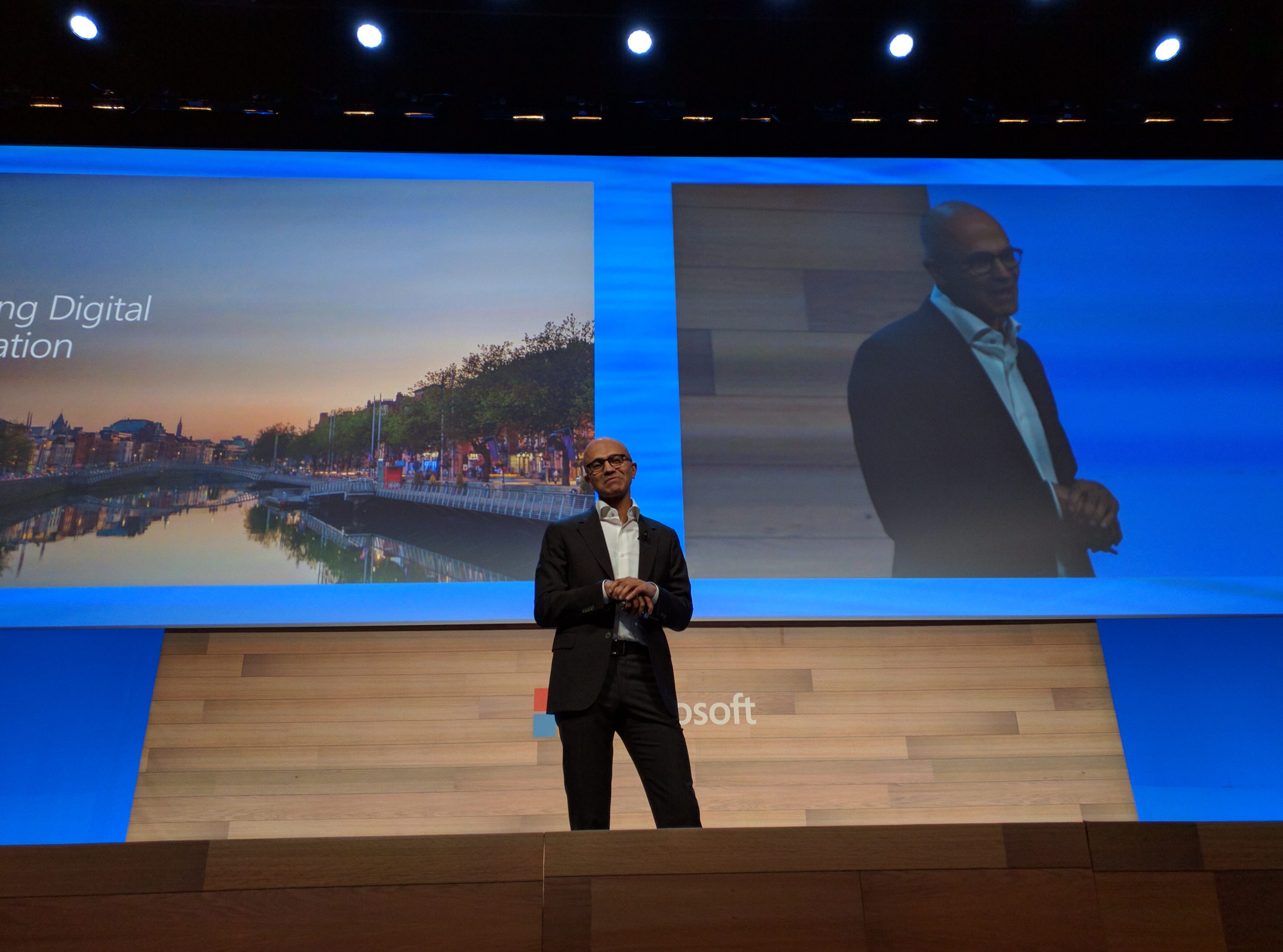
Microsoft CEO Satya Nadella revealed details of the company’s cloud ambitions, elaborating on the ‘mobile first, cloud first’ mantra and covering the use of new technologies to support the use of artificial intelligence and machine learning in applications.
Speaking at the Tech Gathering in Dublin, Nadella explained that the company’s vision is based on the key element of mobility and user freedom, supported by the cloud.
Mantra
“I wanted to get to the very foundation of what drives everything in our company which is our mission,” said Nadella, “to empower every person in every organisation on the planet to achieve more.”
“When we talk about this mission, it is really the north star that drives every decision we make, every customer interaction, every product we build is shaped by this mission.”
Nadella explained that Microsoft is looking to give the user a seamless experience across all devices to enable them to do whatever it is they want to do, while increasing productivity.
“That ability to move between your devices is only possible because of the cloud,” Satya Nadella, CEO, Microsoft
“We of course pursue and build world class technology,” he said, “but it is not about technology, it is about what happens with our technology in the hands of our customers, our partners, whether they be small business, multinational company, entrepreneurs or the public sector. How they can transform using technology and achieve more, is at the centre of who we are as a company.”
“We have a very particular point of view on what we mean by ‘mobile first, cloud first.’ When we say mobile first, it is about the mobility of the human experience, spanning all of the computing in our lives. It is not about the mobility of any single device, it is actually the mobility of your experience across all the devices in your life.
“That ability to move between your devices is only possible because of the cloud,” said Nadella.
Cloud foundation
This cloud foundation for a seamless experience has seen the company invest heavily in its Azure infrastructure, with a $3 billion (€2.68 billion) investment in Europe that has seen facilities established in Ireland, the UK, the Netherlands and Germany, as well as planned facilities in France to come online in 2017.
“That is more regions than any other cloud provider here in Europe,” said Nadella. “In this last year, the capacity has more than doubled.”
However, Nadella emphasised that this was not just about capacity or coverage.
“Cloud computing is not just a single destination, it is a new way of how compute, storage and network come together and create, in fact, a new distributed computing fabric.”
Trust key
Trust, Nadella said, is a key element, and within the European context is becoming more important as the new General Data Protection Regulation (GDPR) looms.
“We are building out this hyperscale cloud so that it can address the legitimate sovereignty and other compliance needs of European countries,” he said.
“It is that real-world understanding of customer needs and requirements of operating in various countries that has lead us to build-out our German cloud with a model where we have a German trustee, in this case Deutsche Telekom, operating that infrastructure.”
Trust and scale are some of the most important elements of our design points for the Microsoft cloud, said Nadella.
Nadella went on to detail several of the technical capabilities of this new fabric, from the use of graphics processing units (GPU) and field programmable gate arrays (FPGA) to machine learning (ML) and artificial intelligence (AI), as well as new topographical considerations for the likes of the Internet of Things (IoT).
Nadella said that true support for distributed cloud infrastructure, or hybrid, “turns out to be perhaps, one of the more unique points of view that we have in terms of how we think cloud computing will shape the future.”
Edge servers
He added that servers at the edge of cloud will facilitate IoT.
“As there is more and more data that gets generated in the edge, you will need more storage and compute in the edge. So you will not just have a throwback to centralised computing anymore. You need true, distributed computing fabric, and that’s what we are building out through both Azure and Azure Stack.”
“These three aspects,” said Nadella, “of building out a global, trusted and hybrid infrastructure is what differentiates our approach to building out a public cloud.”
Nadella argued that it is always the next generation of applications that has driven infrastructure in computing history.
Currently what will define and characterise the next generation is machine learning and artificial intelligence, he said. To that end, Microsoft is building out Azure as “the first AI supercomputer.”
AI supercomputer
Nadella said that not only do you have the capacity when it comes to CPUs and the ability to run virtual machines (VM), whether they are Linux, Windows or containers, it is also supporting as first class some of the best GPU compute capacity.
GPUs, said Nadella, are better at supporting machine learning and the likes of neural networks.
He said that every compute node of Azure, across all regions, now has FPGAs, so that means you can take some of the code that you write and distribute them to this FPGA fabric so you can run them “at the speed of the silicon”.




 Ltd
Ltd