
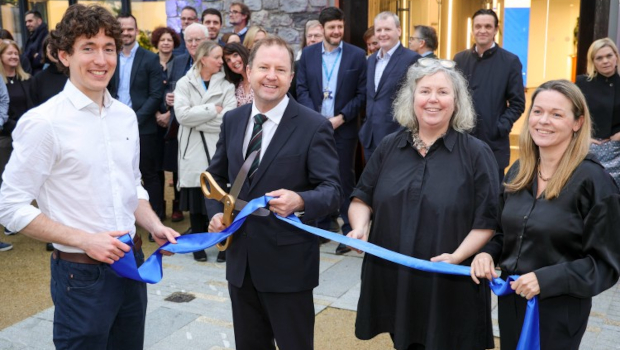
Trinity College Dublin has officially opened its Innovation Hub, bringing researchers, entrepreneurs and industry partners together to develop ideas with economic and societal impact.
Based at Trinity East in Dublin’s Docklands, the Hub was created through the renovation of a Victorian industrial warehouse.
It will support collaboration between researchers across disciplines and external partners, help develop start-ups and spin-outs, and provide industry with access to Trinity’s research expertise, facilities and networks.
The facility is home to established companies and organisations as well as emerging spin-outs working across healthcare, artificial intelligence, energy, reinsurance and deep tech.
Among those based there are Rinn Advanced Therapeutics, Rinn Quantum, PLIO Surgical and eAltra.
Trinity Provost Dr Linda Doyle said universities played a vital role in shaping society and the economy by bringing together research, entrepreneurial talent and the expertise needed to translate ideas into practical applications.
“The opening of the Trinity Innovation Hub marks an important step in our ambition to scale our impact,” she said.
Doyle said Trinity had a strong track record in innovation and entrepreneurship, with more active spin-outs than any other Irish university, adding that its tradition of innovation extended from historical figures such as William Rowan Hamilton and Ernest Walton to its current ventures.
The Hub would create opportunities for researchers, students, entrepreneurs and industry partners to collaborate, innovate and grow, while strengthening the university’s contribution to a competitive and sustainable European economy, she said.
Associate Dean of Innovation Prof Tríona Lally said the facility would enable researchers to interact with people who shared or challenged their ideas, helping bring them to life.
Trinity Director of Innovation Vincent Coole compared the facility with Paris’ Station F and Boston’s LabCentral, saying the Hub would facilitate co-location, collaboration and strategic partnerships.
Trinity said it had produced more than 75 spin-out companies over the past 40 years across medtech, engineering, life sciences and technology.
Its spin-outs raised €108 million in investment in 2025, with medtech firm ProVerum securing $80 million in Series B funding.
Notable companies emerging from Trinity’s innovation ecosystem include Iona Technologies, founded in 1991, which employed around 1,200 people globally at its peak before being acquired for approximately $162 million.
Game and film technology company Havok was founded in 1998 and was acquired by Intel before subsequently being sold to Microsoft.
Inflazome, co-founded in 2016 by Trinity’s Luke O’Neill and Matt Cooper of the University of Queensland, was acquired by Roche for €380 million in 2020.
SilverCloud Health, founded in 2012, was acquired by Amwell alongside Conversa in a deal valued at €270 million in 2021.
Patryk Goron

 Ltd