


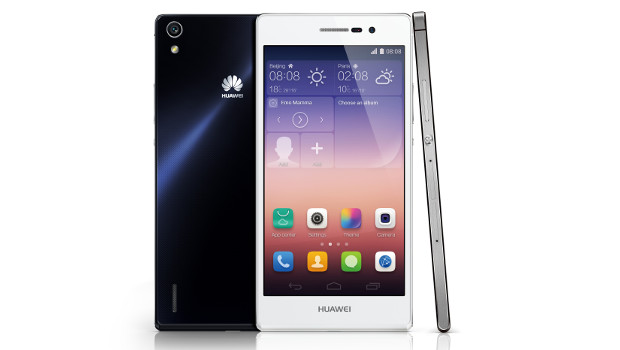
Another unique feature is a camera shooting mode. The P7 has a Sony camera in the back that has a 13Mp sensor, but also a 5Mp front facing camera. That front facing camera can perform a wide angle “selfie” that stiches together multiple frames in a very naturalistic way. It can also apply a “beauty” filter to make you look your best. The effect is for the foreground figures to be nice and crisp and looking well, but with a wide backdrop to perfectly capture wherever it was taken, natural wonder, music festival or historic moment. Unfortunately, not even Huawei’s software wizardry can make you look like any less of a narcissistic plank for taking a selfie in the first place.
Going into the phone itself, Huawei uses a fairly light overlay called Emotion UI which does away with the usual Android launcher and instead relies on an expandable series of home screens for app and function icons, that can be easily grouped into folders, and handily tidied up by shaking the device.
The UI does take some getting used to, but a combination of a set of nice themes and a little work will get you to the point of familiar personalisation. Having become used to the ‘vanilla’ implementation of Android on the Nexus 5, it did take a little adjustment to get the best from an overlay once again.
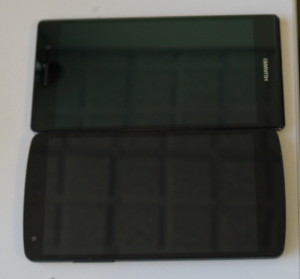
The display bezel is tiny emphasising the full 127mm screen on the P7. (Image: Mediateam)
Battery life is good, as an internal 2,500mAh battery is hefty for packaging method, and aided a few nice features. This is despite the phone having a quad-core 1.8 GHz Cotex-A9, with home-grown HiSilicon Kirin 910T chipset and Mali-450MP4 GPU. There is an emergency battery mode that allows you to have basic phone functionality and contacts only that will squeeze several hours out of the last few charge percentages. There is also a battery monitor that will tell you when something is unnecessarily running in the background or left open, eating your hard earned charge. In practice, I found this a bit naggy, as I’m fairly conscientious about killing apps when done.
The phone manager is also a welcome addition that allows you to see phone health in terms of RAM usage, running apps, memory clean-up and a ‘do not disturb’ feature. A lot of nice apps are nothing new, but the fact that they are bundled increases the out of the box usefulness of the phone, such as a voice recorder, torch, FM radio, notes app and more.
All of which brings us to the price. The non-carrier subsidy price is listed as €449 —significantly less than most other similarly spec’d phones. With a carrier subsidy, this should make this one of the best value handsets available. So combined with its slim, light and attractive packaging, this should be one companion you’ll not tire of over the course of a two year contract.
TechCentral Reporters




Subscribers 0
Fans 0
Followers 0
Followers