


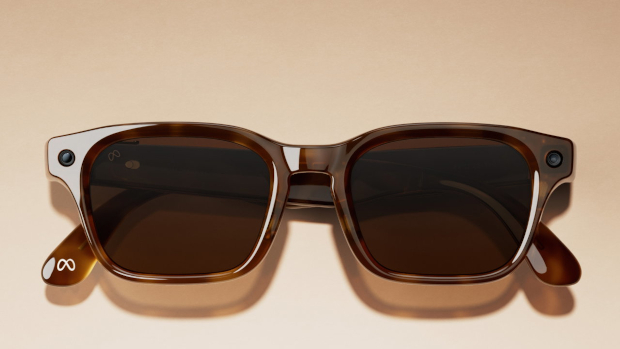
Many, many years ago, I attended an IBM AS/400 press briefing in Rochester, Minnesota. The main event was the appearance of a duo called Timbuk 3 performing their big hit from 1986, The Future’s So Bright, I Gotta Wear Shades. You will not be surprised to learn that, as the song unfolded, IBMers in the audience donned their shades.
I have mentioned this event before but I’m reminded of the song and its tech setting again because of the current furore over Meta’s ‘pervert glasses’ aka Meta AI Glasses. Looking through the lyrics of the song, I laughed out loud at the following couplet:
“Well, I’m heavenly blessed and worldly wise,
I’m a peeping-tom techie with x-ray eyes.”

I’m pretty sure those lines flew over the heads of the techies in the audience in Rochester (and the journalists too) but they seem eerily prescient now: peeping-tom techie. Except with the Meta glasses you don’t have to be a techie anymore, you can be any old dick.
In a recent study of 350 point-of-view (POV) pick-up artist Instagram videos, researchers at the University of Sydney argued that as smart glasses that can record video and audio are often indistinguishable from ordinary glasses, they can “enable new forms of online harassment and gender-based harms that may not be recognised by current online safety or platform governance frameworks”.
They warned that the always-on connectivity of smart glasses integrated with social media platforms “transforms private encounters into public digital broadcasts in real time, leaving the subject no window to intervene or withhold consent”. This constitutes what they dubbed “ambient capture – an omnipresent, clandestine modality of recording where the unwitting subject is transformed into a digital asset for mass circulation, an exchange that operates outside traditional frameworks of informed consent”.
The research found a clear correlation between the covertness of the filming and the severity of the harassment. A sample based on a search for the terms “POV + RIZZ” (point of view and charisma), 60% of interactions were classified as potential harassment and 9.3% as clear harassment. The 96.7% rate of clandestine POV recording corresponded with a 16% rate of persistent pursuit (or continuing to harass after a physical or verbal rejection was issued) and a 62.7% rate of visible discomfort among women.
The researchers argued that smart glasses “limit a woman’s ability to recognise and negotiate her presence during a recording or live stream. As a result, she becomes an imperceptible subject, positioned as the brunt of a joke or a sexualised object in a lure for likes. Wearables exploit this invisibility to produce a condition of structural non-consent”.
Public by design
In response to concerns over covert filming, Meta has highlighted the recording LED and tamper-detection features as evidence of responsible design. But many people have pointed out this puts the onus on those being filmed to notice they are being filmed (which is not easy), to object and to escalate if need be. This doesn’t seem like something most of us would be comfortable doing.
In a recent article for The Guardian, journalist Elle Hunt wore Meta glasses for a month. While concluding that not all users would be ill-intentioned, she added: “I can’t deny: not only do I feel creepy wearing them, but they also lead me to think like a creep… I’m perturbed by how quickly my initial discomfort passes and the glasses become second nature. Just having a covert camera makes me want to use it, the possibilities of the tech overriding my better judgement and even basic decency.”
During a visit to IKEA, she noted: “When a small child crosses my path, I instinctively, immediately whip my head towards the shelves with a sinking feeling. I cannot fathom what sort of person would be untroubled by doing this or, worse, feel entitled to do it.”
Now, advocacy group HateAid has filed a criminal complaint against Meta and retailers for selling AI glasses in Germany, claiming they break the country’s digital privacy laws.
HateAid’s CEO, Josephine Ballon, stated: “Considering the way smart glasses work right now, people aren’t safe anywhere. You have to expect at any moment to be filmed and then be exposed on the Internet. With the sale of Ray-Ban Meta glasses, profits are once again being prioritised over safety. It is unacceptable that corporations like Meta once again try to get away with breaking the law – and profiting from it to enrich themself. Everyone involved in the sales of smart glasses must be held accountable.”
Much attention has been devoted to the manosphere recently – and with good reason. But the adoption of Meta glasses by men as a means to covertly film and harass women makes me think that parts of it would be better described as the creepsphere (or pervsphere).
Predicting what awaits us in the years to come isn’t easy but if we want a bright future, maybe we should avoid wearing shades.




 Ltd
Ltd