


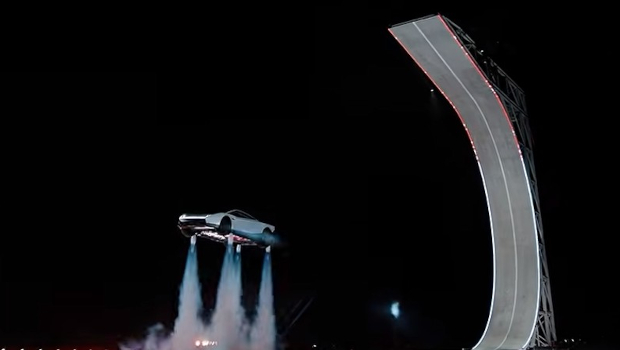
Elon Musk yesterday presented the new Tesla Roadster at a SpaceX test site in Texas and claimed that the vehicle can fly.
The two-seater sports car demonstrated impressive acceleration – a speed of 96 km/h in less than a second. During the presentation, it could be seen how the vehicle, using suction under the bodywork, climbed a steep slope and remained hanging upside down. The car then performed a somersault and landed with the help of integrated air jets.
To limit the risk of serious or fatal accidents during these high‑risk manoeuvres, the car was driven without a human driver.

The propulsion system is based on ten jet nozzles and high‑pressure air tanks. According to Musk, this is thanks to the synergy between Tesla’s expertise in cars and SpaceX’s aerospace engineering. In addition to performing somersaults, the Roadster used these jet nozzles to jump over a row of other Tesla vehicles and reach enormous speed.
Although Musk announced a production target for 2028, sceptics point to his history of overly optimistic timelines.
Conflict between safety and weight
Despite the spectacle, experts are questioning whether the Roadster can actually fly or is only capable of short ‘hops’. The demonstration did not provide any evidence of sustained flight over long distances.
Some experts pointed to the inherent contradiction between the safety requirements in the automotive industry, which call for solid bumpers and crumple zones, and aviation, where keeping weight as low as possible is crucial. According to them, such hybrid designs often result in expensive vehicles that underperform in both areas.
Whether the vehicle will be passed safe for use in the EU is unlikely. Tesla’s iconic Cybertruck found a small following in the US but is unavailable over here as it fails to meet European standards of roadworthiness.
Business AM



 Ltd
Ltd