


| SDN — a little less conversation, a little more action | |
| “After more than two years of very strong growth, there are significant threats on the horizon: continued currency fluctuation, slowdown in markets like China, and an end to the seven-year stock market growth” | 
Agile Networks Darragh Richardson, managing director |
| 2016 won’t be as rosy as many predict. The truth is ICT led the growth out of recession in late 2013 and most probably will lead any slowdown too. After more than two years of very strong growth, there are significant threats on the horizon: continued currency fluctuation, slowdown in markets like China, and an end to the seven-year stock market growth.To counter these headwinds both buyers and suppliers must ask themselves some honest questions: what do they really value — price/quality/relationship/risk? How are they really different from competitors? What is changing for their customers or users?
Within networking we have had 2 years of hype around Software Defined Networking (SDN) and Network Function Virtualisation (NFV). 2016 promises to finally deliver on this promise as vendors are finally splitting apart their hardware and software platforms and selling them separately. It’s not just specialist players like Arista and Extreme who are doing this but mainstream players like Cisco and Juniper, who at first blush might seem most threatened by ‘white box’ solutions. 
Both the traditional vendors and network integrators will have to adapt their business models to become more like software providers. Customers likewise are changing their thinking and 2016 will bring plenty of winners and losers as virtualisation finally comes to networking. Just as virtualisation had a huge impact on compute and storage, virtualisation will challenge traditional network providers to adapt or die. Many customers will continue to buy both hardware and software from the same networking vendor but there is no doubt the market is starting to fragment. 2016 will see some real use cases being implemented as SDN moves away from hype and into some important battles for the future of SDN and NFV. The incumbent vendors will try to develop their own lower cost version of white box solutions to compete with new entrants on one level. On another level these same vendors will compete with VMWare’s NSX to win the orchestration battle with their own proprietary solutions. The general assumption is that the more open platforms will win out — in other words vendors that allow interoperable alliances will offer better choice than closed proprietary systems. What is sure is that the standards bodies are taking too long to reach agreement so it will be a case of vendors working between themselves rather than conforming to an industry agreed standard. What will be interesting to see is which markets adapt to SDN first. International use cases suggest ISPs embracing virtual CPE, datacentres implementing multi-tenant virtual networks, and large scale NAC setting privileges for users roaming throughout a campus or branch virtual network. 2016 will show us how the market here adopts SDN and we at Agile Networks are certainly excited by the opportunity it provides to help customers reinvent what the network can deliver for them.
|
|
| Five trends to watch | |
| “The rise of cloud printing and scanning is often tied closely with the introduction of a BYOD policy. We believe that cloud-based services which link an organisation’s MFPs to mobile devices securely will continue to grow in popularity as more IT managers understand that employee productivity and mobility can be managed effectively in the cloud” |
Ricoh Gary Hopwood, general manager |
| There are a wide range of issues that will make the job of the IT department more challenging, more difficult to predict and also more stimulating in 2016. These include the continuing disruptive impact of new technologies on the way we work, the changing demographic profile of our workforce as well as the increasingly diverse expectation of employees and management alike about how people should be allowed to work, collaborate and share information.And it is in the context of these themes that we have set out our five predictions for the trends and potential developments that we believe are likely to have a significant impact on the IT department over the next 12 months.
1. Smart Operation Panel — The Smart Operation Panel (SOP) is a new and highly customisable tablet-style interface that is integrated with a multi-function printer to enable users to manage their document processes effectively and efficiently. Over the next year developers will create a range of new apps to enhance and broaden the capabilities and productivity of the SOP, and thereby further strengthen its use as an intuitive, touch-screen interface for users to organise and control their printing, whether it’s from a desktop or mobile device, as well as scanning, copying and faxing activities. 2. Cloud printing and scanning — Mobile printing and scanning continues to grow in popularity but it also continues to challenge many IT managers, raising questions about how they should approach issues such as security, control and the governance processes that most organisations will require to ensure the security and integrity of their information. The rise of cloud printing and scanning is often tied closely with the introduction of a BYOD policy. We believe that cloud-based services which link an organisation’s MFPs to mobile devices securely will continue to grow in popularity as more IT managers understand that employee productivity and mobility can be managed effectively in the cloud. 3. BYOD — Many IT departments view BYOD as an unnecessary risk that should be resisted. We believe that BYOD will continue to make greater inroads into mainstream corporate organisations during 2016. In addition, forward-thinking IT departments will realise that BYOD in itself is not a problem. It’s the lack of clearly-articulated policies, security frameworks and governance models to manage such devices in the workplace that are the real challenge. In 2016 more IT managers and senior management teams will come to accept BYOD as an inevitable development and will look to deploy it to enhance the productivity of their workforce. 4. Generation Z — The profile of our workforce is changing and we’re likely to see a great deal more innovative approaches and new thinking in the way organisations plan to cater for the needs and wants of their employees. Baby Boomers, Generation X and Millennials who make up our workforce currently, are about to be joined by Generation Z. This new group refers to those who are born after 1995 and are starting to leave education for the world of work. According to recent research into the 4G Workplace, commissioned by Ricoh, Generation Z is likely to be attracted to companies that offer technology to enable people to work more efficiently. 5. Evolving role of the IT department — The changing role of the IT department is set to accelerate rapidly over the next year. The traditional view of the role of the IT team as the custodian of IT infrastructure is set to change. Many more IT managers will see themselves as workstyle innovation champions and enablers of organisational productivity and more IT departments will expand their set of responsibilities to include employee empowerment. Increasingly IT managers will work closely with managers in other departments to identify and implement new technologies and new ways of working to support the changing workstyles of their employees and thereby help to create more agile, mobile and productive organisations.
|
|

| 2016: Trends and Predictions | |
| “Developers need to be more security conscious, creating smarter apps which can detect and respond to potential threats. For example, many mobile banking apps today can detect if a device has been modified to run on software which hasn’t been approved by the manufacturer” | 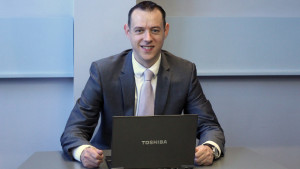
Toshiba Damien Farrell, B2B reseller channel manager – Ireland |
| Security remains critical for businesses when it comes to executing an efficient and successful IT strategy. Workers today are adapting to smarter mobile hardware and so they increasingly expect to be able to work from a variety of apps on the move, particularly as this way of working and communicating has already become so prevalent in the consumer space. In particular, given the rise of mobility and app usage, we believe we will start to see more intelligent security built into enterprise apps.Currently, apps often lack the sophistication the wider hosting platform is able to offer — passwords alone are no longer sufficient given the increased professionalism and cunning of hackers. Instead, developers need to be more security conscious, creating smarter apps which can detect and respond to potential threats. For example, many mobile banking apps today can detect if a device has been modified to run on software which hasn’t been approved by the manufacturer. These apps will detect the vulnerabilities this potentially leaves the person’s data open to and not run. Soon these apps will be capable of taking this a step further, detecting if a handset has been tampered with, identifying the breach and automatically and immediately triggering a security defence. This could be notifying the bank and account holder, or simply closing down the app as an immediate precaution.
On the flipside, manufacturers and businesses also need to value the importance of the hardware itself. As many organisations shift to the cloud, and concerns about data centre security continue to rise up the agenda, businesses have rightly moved to ensure their cloud solutions are safe and with reputable vendors. However, while companies shift their focus to the cloud, some have neglected the role their laptop or tablet plays in data security. Devices built for business, such as Toshiba’s Satellite Pro A50-C, are designed with security front-of-mind, featuring in-built barriers which offer a defence whether the laptop is left on the train or stolen. In line with the shift to mobile working, there are also solutions available such as Toshiba’s Cloud Client Manager Mobile (TCCM) which offer mobile device and application management across a host of operating systems, providing peace of mind for businesses as their employees become more comfortable with using cloud technology while working on the move. The focus for many vendors in 2016 will be on continuing the development of tools like this which can concurrently enable business to perform both more efficiently and more securely.
|
|





 Ltd
Ltd