


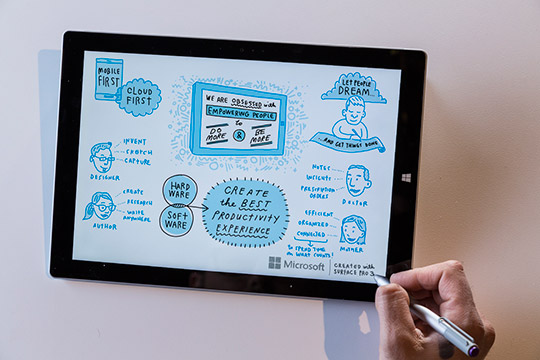
Well, the thinner, lighter, more powerful mantra is a good one, but the prices are a bit salty. So what else does the SP3 do over the SP2? The ‘pen and paper’ experience seems to the main selling point. Panay demonstrated using the new pen, with eraser and click button, which gave a very natural looking writing experience, even getting the New York Times crossword into the act, where handwritten input was instantly and accurately digitised. It was very impressive and as a journalist, something I would be very interested in because while I can easily use my SP2 on my lap during a keynote to take notes, it is not so conducive while doing interviews, so a more natural pen and paper style experience would allow me to ditch the A5 spiral bound for good. But is it enough to tempt the SP2 owners? Perhaps not, but it is for SP1 owners.
Redmond then seems to be looking to convince anyone who hasn’t bought a laptop in the last year or so and now needs one that there is a tablet experience out there that will allow them the full productivity of a laptop while also giving a good account of itself as a tablet — that very personal device. Again, going for the slow burn approach, Microsoft is using its strength and position to take the pain initially to carve out its new niche. And fair dues to it, I have been convinced since I adopted the original Surface Pro as my main machine.
But the SP3 announcement was not without its controversy too, and not for what was said, but rather for what wasn’t.
There had been rumours swirling for some time about what would be announced in New York, and among them were those of a Surface mini, probably an 8” device, and a new Surface — sporting the RT version of Windows.
The complete failure to even mention RT at the New York announcement of the SP3 perhaps speaks volumes
After the last update where the Surface RT got renamed just as Surface, many, myself included, asked if RT had done its job and could it be let go quietly into the night after a reasonable support period. Well, I was told by a representative in Ireland to watch this space, but the complete failure to even mention RT at the New York announcement of the SP3 perhaps speaks volumes.
In recent times, Microsoft has battled hard to make Windows 8.1 run on increasingly modest specifications, which prompted many of the rumours around an 8” device to bear the Surface name. But, one had to ask, why do this when the RT version was already there and already adapted for the niche? Well, it would make sense if RT was already slated for the slag heap.
With lukewarm app developer support, limited availability of common apps such as browsers and email clients, RT never really took off as a ‘walled garden’ approach, as had iOS. While the Surface RT and Surface 2 were very good devices, the whole value proposition never quite made it and Redmond took a major bloody nose for it with unsold inventory and a whopping write down.
The entire tone of the SP3 announcement was around the device being a very good tablet, but also a damn good laptop with the addition of minimal accessories. There was little of the magic of ownership guff, which is a good thing. The point seems to be that Microsoft, in not announcing a Surface mini or Surface (RT) update, is setting its sights firmly on those who want a tablet that is more than a trinket for consuming information. The ‘one device’ approach is a good one and the SP3 seems to be the best stab at it so far, unless there is an RT announcement very soon, Redmond’s candour in the SP3 announcement would seem not to extend beyond it. The ‘let’s never speak of it again’ approach speaks volumes in itself.





Subscribers 0
Fans 0
Followers 0
Followers