


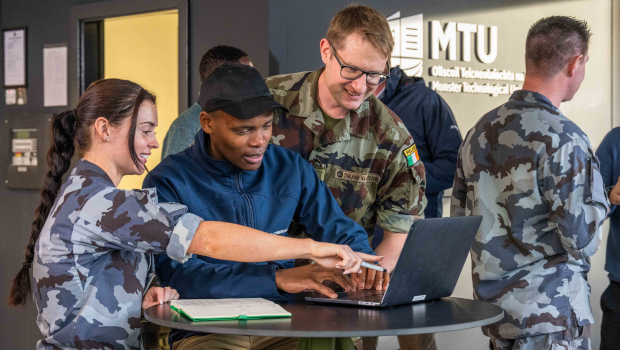
Munster Technological University (MTU) brought together members of the Irish Naval Service, the Defence Forces, researchers and students for a simulated cyber attack on a maritime port and ship.
The Cyber Security Smart Maritime Challenge 2026 took place on Friday, 9 October, at MTU’s Cyber Security Prototyping Lab in the Nimbus Research Centre in Cork.
Designed by Airbus in collaboration with Cyber Innovate, the National Maritime College of Ireland (NMCI) and MTU’s Department of Computer Science, the exercise simulated an attack on critical maritime infrastructure.

A threat actor group paralysed a port’s IT systems and disabled a ship at its entrance, blocking maritime traffic.
Five teams were tasked with identifying the points of attack, regaining control of the vessel and supporting Europol in apprehending the group’s leader.
The exercise was hosted by MTU’s Department of Computer Science, Cyber Security Research and Innovation Centre, NMCI and the Cyber Innovate programme.
The postgraduate programme aims to equip professionals with the expertise and networks to identify significant cyber security problems, establish and lead cyber security start-ups.
The challenge comes amid growing attention to the protection of Ireland’s maritime infrastructure.
In February 2026, the Government unveiled the country’s first National Maritime Security Strategy, which aims to strengthen the protection of Irish waters and critical maritime infrastructure and improve cooperation with EU and international partners.
Cyber threats to critical infrastructure are among the risks identified in the strategy.
Ronan Coleman, director of Cyber Innovate, said the exercise was particularly relevant as maritime security and defence had become a significant national focus since Ireland took up the Presidency of the Council of the European Union in July.
“Collaboration is key, and bringing together the Irish Navy, Defence Forces, maritime experts and cyber security specialists offers our students the opportunity to develop deep insights into how threat actors target critical infrastructure,” Coleman said.
He added that the experience would help participants develop the skills needed to respond to attacks and could lead to the creation of new products and solutions.
George O’Mahony, head of MTU’s Department of Computer Science, said preparing for incidents before they happen was critical to protecting maritime infrastructure.
“Through realistic simulations like the Cyber Security Smart Maritime Challenge, running on a state-of-the-art cyber range platform, participants can experience the complexity of responding to a major cyber attack, develop their technical and problem-solving skills, and learn how to make decisions under pressure,” O’Mahony said.
He said the exercise also gave students and researchers insights into the challenges facing the maritime sector and helped develop the skilled workforce needed to respond to emerging threats.
MTU runs multiple programmes and initiatives, including the MSc in cyber security and BSc(Hons) in IT management and cyber security in the dept. computer science, cyber innovate, cyber skills, cyber explore, cyber resilience, cyber safety, and cyber futures.
MTU’s graduates contribute to Cork’s reputation as Ireland’s cyber security hub, helping to attract national and international companies to the region.
The university also operates two cyber range infrastructures, comprising cloud-based and mobile platforms. These allow simulated attacks on virtual organisations without risking real-world damage or service outages.
Cyber Innovate is co-funded by the Government of Ireland and the European Union through the ERDF Southern, Eastern and Midland Regional Programme 2021–27.
Patryk Goron





 Ltd
Ltd