


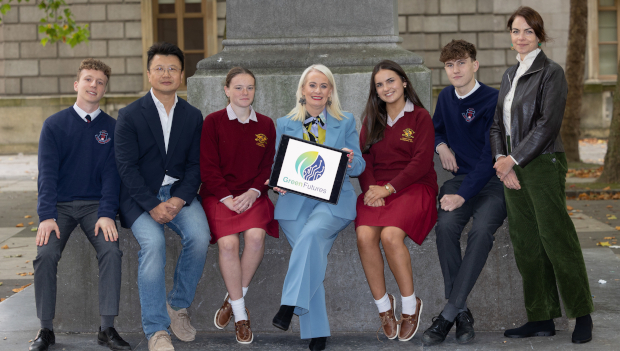
A new national education initiative launched today will help Transition Year students understand how artificial intelligence (AI) and climate change are reshaping their world and to explore the role technology could play in building a more sustainable future. This is the first time AI and climate literacy have been linked in a focused educational programme.
GreenFutures, a free four-lesson programme developed by the Adapt research centre at Trinity College Dublin, in partnership with UNESCO through its office in Venice and supported by Huawei Ireland, was launched today by Minister of State for Trade Promotion, Artificial Intelligence and Digital Transformation Niamh Smyth.
The initiative contributes to a wider European conversation about how science education can prepare young people for a future increasingly shaped by artificial intelligence, climate change and rapid technological transformation.
Through classroom resources, real-world case studies and interactive activities, students examine how AI and digital technologies are being used to understand climate change, monitor biodiversity, support more sustainable systems. They also consider important questions around energy consumption, responsible innovation and climate justice.
Across four connected classroom-ready lessons, students explore climate change through data; artificial intelligence, ethics and climate solutions; sustainable systems spanning energy, nature, food and cities; and climate justice, futures thinking and green innovation. Rather than simply teaching students what to think, GreenFutures encourages them to think critically: to ask better questions, evaluate evidence and consider how technology can be developed and used responsibly.
The programme has been informed by UNESCO’s work on the International Decade of Sciences for Sustainable Development (2024-2033), Education for Sustainable Development, the Greening Education Partnership and the Ethics of Artificial Intelligence, recognising that climate literacy and digital literacy are increasingly interconnected as education systems prepare learners for the future. GreenFutures also builds on Adapt’s internationally recognised research in the field of artificial intelligence, digital content technologies and public engagement, bringing current research into classrooms in an accessible and engaging way.
Huawei Ireland CEO, Calvin Lan, said: “Technology has a vital role to play in supporting sustainable development, but it is equally important that future generations understand both its potential and its responsibilities. Through our partnership with Adapt and UNESCO, GreenFutures will help students develop the knowledge and confidence to engage with climate action, digital transformation and responsible AI in meaningful and practical ways.”
GreenFutures is one of the five pilot initiatives selected under the project Digital Futures for a Smart Europe: A Feasibility Study on Digital Transformation and Green Innovation, implemented by UNESCO and funded by Huawei Technologies. Launched across Europe, the project aims to assess the current state of digital and green innovation ecosystems in five countries and to evaluate the feasibility of a future regional initiative. GreenFutures focuses on Irish Transition Year students and provides classroom-ready lesson plans, student activities, videos, discussion guides and practical learning resources aligned with national curriculum frameworks.
TechCentral Reporters



 Ltd
Ltd