

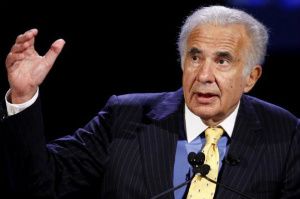
Billionaire trading agitator Carl Icahn said he has lobbied Apple CEO Tim Cook for a $150 billion stock buyback programme, a 150% increase over the company’s current plan.
"Had a cordial dinner with Tim last night. We pushed hard for a $150 billion buyback. We decided to continue dialogue in about three weeks," Icahn said via Twitter.
Apple shares were up 2.6% in trading Tuesday, pushing close to $489 a share.

It was the fourth time in the last six weeks that Icahn, known as a corporate activist, tweeted about dealings with Apple. On 13 August, Icahn revealed that he had acquired "a large position" in Apple, that he believed the stock to be undervalued and that he had spoken with Cook about an increase in the company’s buyback initiative.
Ten days later, he turned to Twitter to say he had lined up dinner with Cook and would be pressing the CEO on stock buybacks.
Icahn typically buys a stake in a company to demand management changes and advocate the use of cash reserves to boost the share price, including paying higher dividends or buying back shares. The latter is Icahn’s strategy with Apple.
Icahn has not revealed the exact size of his holdings. In filings with the US Securities and Exchange Commission (SEC) for the quarter ending 30 June, the one most recently reported, Icahn said he owned no Apple stock, meaning that his purchases began on or after 1 July. Icahn will be required to disclose his holdings for the third quarter, so his holdings will be public some time this month.
Last year, Apple said it would use $10 billion to fund buybacks that would retire shares and thus increase the value of those still remaining. In April, the Cupertino, California, company increased the buyback program to $60 billion, which is to be spent through 2015.
Icahn, however, wants even more spent on buybacks and has suggested that if Apple borrowed to do so, it could retire enough shares to boost the price above $700, or where it was more than a year ago before taking a plunge as investors worried about the lack of new products and questioned the company’s commitment to growth.
Apple could well afford an increased buy back. At the close of the quarter that ended 30 June, it reported nearly $147 billion in cash, securities and other investments. Most of that, however, was banked overseas to avoid paying higher rates of corporate tax in the US.
In fact, Apple borrowed some of the money it will use on its current buyback arrangement.
Icahn played a major role in opposing Michael Dell’s bid to privatise the PC maker that carries his name. In early September, however, Icahn and his associates tossed in the white towel, even as he claimed his opposition prompted Michael Dell and his investors to bump up the price they’d pay for each share.
Those shareholders approved the $24.9 billion privatisation deal on 12 September.
IDG News Service





 Ltd
Ltd