



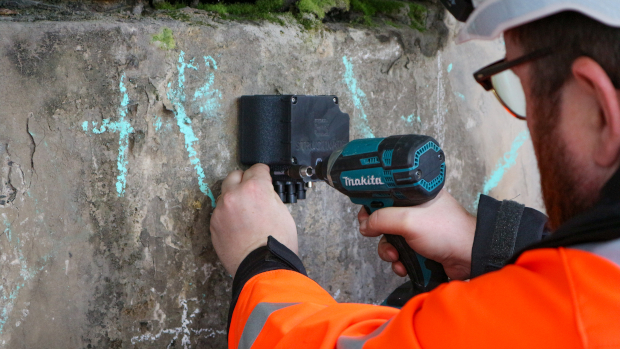
A Technological University Dublin spin-out has deployed its sensor technology on Lifford Bridge in a bid to provide continuous monitoring of corrosion in the 62-year-old structure.
The deployment of four SM sensors on the bridge’s half-joint connections was completed in July by Dr Sean Bond, project lead for SM at TU Dublin, in partnership with the Department for Infrastructure in Northern Ireland.
Live data was being transmitted from the sensors before the project team left the site.

Lifford Bridge spans the River Finn between Lifford in Co Donegal and Strabane in Co Tyrone. Its half-joint connections are critical load-bearing points that can be vulnerable to hidden corrosion.
SM’s sensors are core-drilled and grouted into structures and continuously measure corrosion activity, concrete resistivity, temperature, humidity, vibration and tilt.
The data is fed into an analytics platform that uses machine learning and other analytical tools to turn sensor readings into information for infrastructure owners.
“Lifford Bridge is exactly the kind of structure SM was built for, ageing reinforced concrete, critical half-joints, and decisions that until now had no continuous evidence behind them,” Bond said.
He added: “Going from the Commercialisation Fund award to live data on a real bridge in under two years shows what’s possible when the research has the right support behind it.”
The project is supported by a €1 million award from Enterprise Ireland’s Commercialisation Fund, which was secured in November 2024. The fund supports the commercialisation of technologies developed in Irish higher education institutions.
SM is currently in its pre-commercialisation phase, with the technology due to transfer to its commercial entity by 2027.
Bond is directing the SM Trial programme, which is working with infrastructure owners, government agencies and local authorities across Ireland and the UK.
Further deployments are planned before the Enterprise Ireland programme concludes in 2027, including a confirmed deployment on the Woodside Viaducts in Glasgow with Transport Scotland.
The SM technology was developed by Bond at TU Dublin and combines retrofitted sensors, real-time data analytics and decision-support tools to enable infrastructure owners to move from periodic inspections to continuous corrosion monitoring.
Patryk Goron



 Ltd
Ltd