


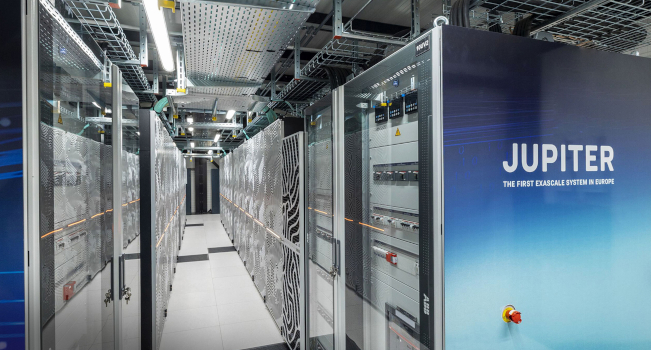
Red tape and complex funding model leave Germany’s Jupiter supercomputer underused
Germany’s ambition to guarantee technological independence through the Jupiter supercomputer is currently being hampered by administrative sluggishness, reports German business news outlet Handelsblatt.
Industry leaders such as Jarek Kutylowski of DeepL have stressed the urgent need for such computing power in order to remain competitive in a rapidly changing market, but practical use by private companies has ground to a halt.
The main obstacle was a series of lengthy approval procedures and tendering hurdles. Reports indicate that commercial entities had no access to the system’s capabilities for several months after its unveiling. While political rhetoric emphasised the importance of sovereign computing power for national security and economic viability, the reality was that there was no official authorisation for private-sector activities.

In the fast-moving world of AI development, that delay is crucial. Since its launch, Jupiter has already dropped down the global rankings, while competitors such as OpenAI and Anthropic continue to make progress and Chinese open source models gain the upper hand.
In addition, the project’s complex funding and legal structure has caused significant friction. Because the system is co-financed by the European Union’s EuroHPC and various German ministries, it has been a bone of contention who should bear the high costs of training large-scale models.
Legal clarifications regarding commercial use have only recently been completed, and the operator is still working on setting a non-profit pricing model. On top of that, EU state aid rules strictly limit commercial use to 20% of annual capacity in order to preserve the project’s status as being of general interest, effectively giving scientific research priority over product development by companies.
Technical malfunctions
Alongside the administrative red tape, technical and staffing problems have complicated the rollout. The enormous system, with 24,000 GPUs, has suffered from typical teething troubles in cooling, power supply and processor integration.
This is exacerbated by a severe shortage of GPU specialists in Germany. There is also the risk of rapid obsolescence. While Jupiter uses Nvidia’s Grace Hopper architecture, newer facilities are already switching to the more powerful Blackwell generation.
Despite these setbacks, the supercomputer has already proved its worth in academia, notably by winning an award for highly accurate climate modelling.
Interestingly, while German start-ups struggled with local bureaucracy, a Finnish company, Tilde, did gain access to the system by applying through EU-wide channels instead of national ones, highlighting the discrepancy in accessibility.
Business AM




Subscribers 0
Fans 0
Followers 0
Followers