


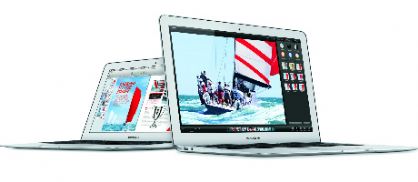
As well as announcing new versions of iOS and OS X, Apple announced some new hardware at WWDC yesterday, including a return of the Mac Pro.
Based on a new fourth-generation Core processor called Haswell ULT – the replacement for Intel’s Ivy Bridge processor – the new lightweight notebooks feature significantly longer battery life, faster graphics performance, improved wireless networking, and greater energy efficiency.
The 11" Air improves from five hours of battery life to nine hours, with standby for up to 30 days. The 13" Air goes from seven hours to 12 hours of battery life. Wakeup time is one second.

Designed for power savings, with more energy-efficient Intel Core i5 and Core i7 CPUs, the new Airs have a slower clock speed while still delivering 40% faster graphics performance, Apple says. The MacBook Air is based entirely on Flash storage, and is up to 45% faster than the previous version.
Graphics performance
The MacBook Air’s new Intel HD Graphics 5000 up to 40% faster performance for gaming and graphics intensive programs, while the new Flash storage offers speeds of up to 45% faster than the previous generation and nine times faster than traditional hard drives, according to Apple.
Other features include dual microphones, a FaceTime HD camera, a high speed Thunderbolt port and two USB 3.0 ports. The new MacBook Air models also support dual displays and video mirroring alongside full native resolution on the built-in display.
AirPort redesign
Wi-Fi is reportedly three times faster in the new MacBook Air, but networking improvements depend on a new simultaneous dual-band, three-stream 802.11ac base station. Not coincidentally, Apple also introduced redesigned AirPort Extreme and AirPort Time Capsule (2Tb or 3Tb) base stations that feature three-stream 802.11ac with a maximum data rate of 1.3Gb/s. The new base station features what Apple calls a beamforming antenna array. Unlike base station antennas that emit an equal and constant signal in all directions, the beamforming antenna array knows where an 802.11ac device is on the network and targets the signal to that device.
The MacBook Air comes in an 11" model, starting at €1,049 with 128Gb SSD (twice the on-board storage at the same price as before). A second 11" version comes with 256Gb of storage for €1,249. The 13" MacBook Air also comes in 128Gb and 256Gb capacities, which cost €1,149 and €1,349, respectively.
Airport Extreme and AirPort Time Capsule are also available today. AirPort Extreme is €199. AirPort Time Capsule comes in two models: 2Tb of storage for €299 and 3Tb of storage for €399.
Mac Pro
Apple’s redesigned Mac Pro desktop will be available later this year in a vastly smaller, and cylindrical box that adds PCIe Flash storage technology, an upgrade that promises to boost performance by 10 times over the hard drives in current models.
PCIe, or peripheral component interconnect express, is a high speed serial expansion card format that uses a point-to-point architecture. PCIe-based flash has far better performance than more typical SATA- or SAS-connected solid state drives (SSD) or flash because of the direct connection to peripherals. There’s no translation layer required.
The Mac Pro’s new Flash internal storage will offer astoundingly fast 1.25Gb/s reads and 1Gb/s writes. By comparison, a top-rated laptop solid state drive using a SATA II interface tops out at about 550Mb/s, about half that of the PCIe flash Apple will be rolling out.
While a first for Apple as a native offering, PCIe cards on PCs are not new. For instance, Fusion-io’s ioFX [PCIe flash card] has been available for some time.
The Mac Pro, due out this autumn, will have a round shape and is about one-eighth the size of the current model, according to Cook.
The system will also be the first Mac Pro with dual workstation GPUs – AMD’s FirePro Graphics chip, which can deliver up to 528Gb/s total bandwidth and 7 teraflops performance over OpenCL.
The system will come with four USB 3.0 ports, six Thunderbolt 2 ports, Gigabit ethernet, HDMI out, and motion sensor that lights up the back panel when its turned.
IDG News Service





 Ltd
Ltd