


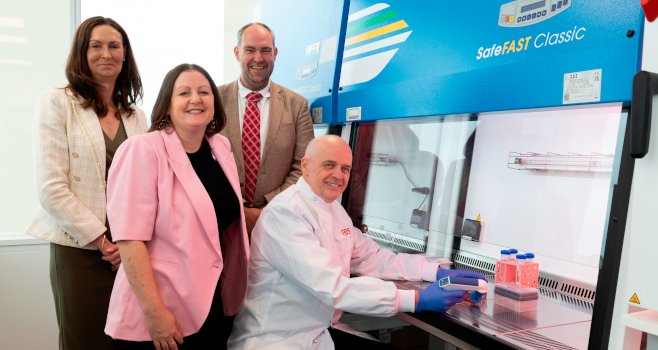
Minister for Further and Higher Education, Research, Innovation & Science James Lawless has announced a new €2 million Strategic Partnership Programme award, co-funded by Research Ireland and the Irish Blood Transfusion Service, to support research into how biological differences between blood groups influence the body’s ability to control bleeding.
The four-year Irish ABO and Coagulation (iABC) study is led by Prof James O’Donnell at RCSI University of Medicine and Health Sciences.
Although blood groups are known to play an important role in bleeding and clotting, the reasons for these effects are poorly understood. People with blood type O, in particular, are known to have higher risk of excessive bleeding. This has important implications for many women, as heavy menstrual bleeding is common and can lead to iron deficiency and reduced quality of life. The iABC programme will investigate these links by analysing blood samples and health data from Irish blood donors.

IABC is the first large-scale programme of its kind in Ireland. It will recruit 1,000 Irish blood donors, creating a unique national biorepository to support future research. The findings have the potential to improve the treatment of bleeding disorders, support safer and more effective transfusion processes, and inform care for patients in emergency situations. The programme will support six early-career researchers over the 48-month duration, including three PhD students and three postdoctoral researchers, helping to build capacity in cardiovascular and transfusion research in Ireland.
Prof James O’Donnell, Professor of Vascular Biology at RCSI School of Pharmacy and Biomolecular Sciences and lead of the iABC study, said: “The importance of the ABO blood group system in blood transfusion medicine has been recognised for many decades. In contrast, although there is strong evidence that ABO also influences risks for bleeding and thrombosis, the biological mechanisms involved remain poorly defined. The novel research plan envisaged in this partnership will directly address this important clinical question.”
Orla O’Brien, CEO of the Irish Blood Transfusion Service, added: “This is a natural and synergistic partnership for both our organisations, given the Irish Blood Transfusion Service has a long-standing commitment to deepening our understanding of blood donation, transfusion, and usage. Supporting health research that expands our knowledge of bleeding, is crucial to improving donor care, patient outcomes, and ultimately, quality of life.”
TechCentral Reporters




 Ltd
Ltd