



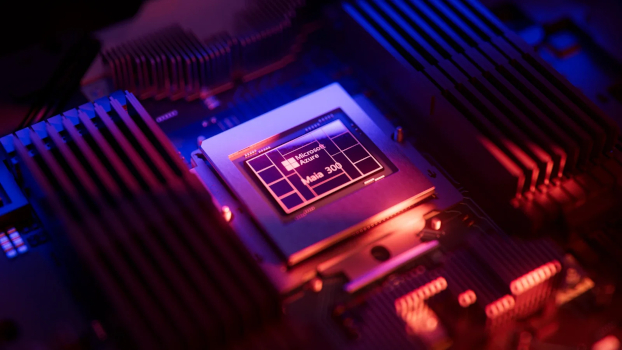
In an effort to cut operational costs, Microsoft has unveiled the Maia 300, the third iteration of its own AI hardware.
The company plans to integrate more than 1 million of the processors into its internal infrastructure by next year to support a wide range of AI-driven features, including automated coding and advanced business operations.
Although earlier versions are already powering Microsoft’s own AI and OpenAI’s models via the Azure platform, this new generation marks a strategic move to reduce dependence on Nvidia’s market dominance.

In terms of architecture, the Maia 300 departs from Nvidia’s design, which typically couples one large processor with high-bandwidth memory. Instead, Microsoft is using a ‘chiplet’ approach.
Critical computing components are built using TSMC’s advanced 2nm process, while less demanding tasks, such as internal data transfer, use the more cost-effective 3nm technology.
Efficiency and power management are central to the new design. A rack with 96 Maia 300 chips consumes around 167 kilowatts, while a newer Nvidia GB300 rack uses 142 kilowatts but contains fewer units (72 GPUs). Microsoft claims its system delivers about 40% more computing power per megawatt than leading GPU alternatives.
Rani Borkar, who heads Azure’s hardware systems and infrastructure, noted that the goal is to maximise the output of every watt, dollar and byte of memory through extensive system optimisation.
Looking ahead, Microsoft is preparing for large-scale deployments of the Maia 300 with a capacity of several gigawatts, set to begin next year.
This initiative aligns with the company’s aggressive financial strategy, under which it expects capital expenditure in the current calendar year to exceed €157 billion.
Business AM



 Ltd
Ltd