


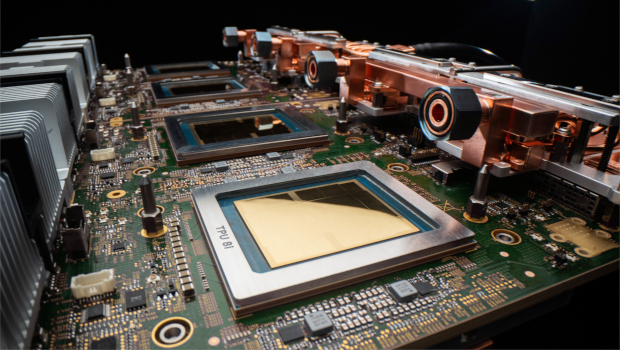
In a bid to step up competition with Nvidia, Google is introducing two custom-designed tensor processing units (TPUs). According to Amin Vahdat, head of Google’s chip division, the TPU 8tx and TPU 8i Max are being announced today. Their launch is scheduled for next year, Bloomberg reports.
The TPU 8tx is specifically designed for tasks requiring a high level of security. The chip targets businesses in heavily regulated sectors and government agencies.
By integrating an AMD processor, this chip enables data encryption directly at the hardware level. Vahdat noted that this is a significant improvement, as data typically has to be decrypted in system memory during processing.

The TPU 8i Max, by contrast, targets AI capabilities that require expanded context windows – the amount of data a model can process in a single query. This capability is particularly crucial in fields such as software engineering, mathematics and pharmaceutical research. To achieve this, the 8i Max combines two TPU chips, increasing total memory and computing power.
These new products are not entirely original architectures, but modified versions of existing chips tailored to specific customer needs. This shift towards specialisation marks a change in strategy, as Google previously followed a two-year release cycle for its processors. Vahdat explained that developing purpose-built hardware delivers greater benefits than building a single universal chip for the entire market.
While Google’s TPUs are challenging Nvidia’s GPUs, they have already attracted major customers such as Oracle, Meta and Apple. Regulatory filings also show that Anthropic has an agreement to purchase up to $150 billion (€134 billion) worth of these units between 2028 and 2031.
Nvidia is pursuing a similar path towards diversification by developing its own CPUs and using Groq’s technology for inference-specific hardware.
In a landmark move, Google and Oracle have announced that TPUs will be accessible through Oracle Cloud Infrastructure from 2027; this is the first time these chips will be available on a competitor’s hyperscale cloud service.
Google currently works with Broadcom on design and TSMC on manufacturing. However, the company faces supply chain constraints. Recent financial reports show that the entire existing TPU inventory has already been reserved.
To address shortages in production capacity and memory, Google intends to expand its supplier base, although Vahdat did not specify whether companies such as MediaTek or Marvell Technology would be involved.
Business AM


 Ltd