


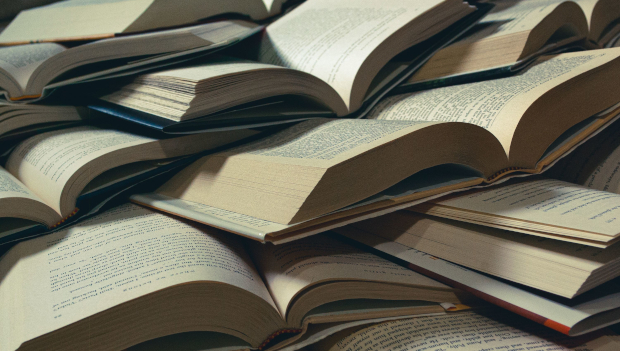
Jim Shaughnessy, who runs a bookshop in Claregalway, Co Galway, has spent months fielding orders that make no sense as collections: veering from a history of farm machinery in colonial Africa to a long-dead racing driver’s biography, nothing connecting one title to the next. Booksellers across Ireland and the UK reported the same pattern, and until recently the best anyone could offer was a theory that somewhere at the end of the chain an AI company was indiscriminately buying by the pallet.
That theory has since been validated: in July the outlet 404 Media hid a tracking device inside a rare book buried in a 1,000 book order and followed it across the US to an Amazon warehouse in Las Vegas. This facility is staffed by workers whose job is simply to cut the bindings off books so the pages feed into a scanner faster. In what could be described as bad taste, this operates under the logo of a dinosaur gripping a book in its claws, appearing on the cusp of devouring it. Amazon didn’t deny it, telling reporters that it purchases books through commercial channels to improve the products and services its customers use.
Anthropic, meanwhile, has its own documented programme, candidly named Project Panama in internal filings that describe it as an effort to destructively scan all the books in the world. Anthropic disputes that rare or antiquarian titles are specifically targeted but between them, two of the best-funded AI labs on earth are currently running what amounts to an industrial disassembly line for the printed word.

But Amazon’s book eating dinosaur has no real idea of what’s actually inside one. For example, Trinity College holds the world famous Books of Kells that has, buried within its margins, several 11th and 12th century property deals, scribbled in alongside the gospels because a sacred book was apparently also a convenient place to notarise a land sale. The manuscript itself contains the odd repeated paragraph and dropped sentence, proof that even the most painstaking scribes in Christendom occasionally lost the thread.
Marginal gains
Ireland’s finest contribution to this tradition might be Pangur Ban, a ninth century poem written by a homesick Irish monk comparing his own hunt for life’s meaning to his cat’s hunt for mice. Nobody remembers the manuscript he was actually meant to be copying but everyone remembers the cat.
This isn’t mere whimsy, it’s a recognised field of study. For example, H.J. Jackson, author of Marginalia: Readers Writing in Books spent his entire career cataloguing this exact kind of note, including French polymath Pierre de Fermat, who wrote in his copy of Diophantus that he’d found a brilliant proof but that the margin was too narrow to fit it in. This singular sentence occupied mathematicians for the guts of 350 years.
And there’s the famous printing known as The Wicked Bible owning to it dropping one word from the seventh commandment resulting in the line “Thou shalt commit adultery”. All copies were ordered to be burned but some survived and one sold at Sotheby’s in 2018 for US$65,250.
These are the things no scanner is built to want. It wants to digitise the clean text underneath and destroy all that remains. There goes the scandalous misprint, the moving medieval cat poem in our teanga, and the more common but no less touching countless inscriptions to loved ones – all those windows into lives in the past. So, yes, the original text of the book survives, some would say more durable than it’s ever been, but what gems are being lost forever? The joke is that between them, Amazon and Anthropic may end up preserving literature perfectly while losing, one severed spine at a time, every reason a particular copy of it was ever worth holding onto.

 Ltd
Ltd