

One of the unexpected upshots of the Covid-19 pandemic was the revelation that global supply chains had been stretched to breaking point. Thanks to decades of leadership from business school brain-addled executives, so-called ‘just in time’ logistics came to be seen as more efficient. Efficient, yes. Able to cope with problems? Not so much, it turns out.
When you think about it – and few of us did – it is obvious. With components alone coming from all over the world and a doctrine that meant warehouses were out and lorries in (never mind that the latter was effectively doing the job of the former), it is no surprise that our supply of goods, not least information technology hardware, could not withstand a tug on the chain.
How fragile we are, how dependant on the caprice of others. I was reminded of this recently following remarks made by Hermann Hauser, founder of of venture capital firm Amadeus Capital Partners.

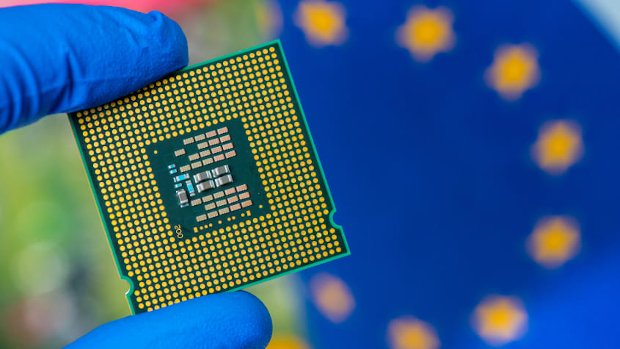
Noting European countries were entirely dependent on US-owned intellectual property, and alleging that former US president Donald Trump capitalised on our lagging in semiconductors in particular, wielding technology as “a weapon to force other countries […] to do what he wants,” Austrian Hauser took aim at all of Europe but reserved special scorn for his adopted homeland of Britain, saying it had “no chance in hell” of being technologically independent.
Countries across Europe will “just have to find our own independent access to critical technologies,” Hauser said.
So what? Who cares what some private investment fund manager thinks? Fair enough, but Hermann Hauser is not just another fund manager. He co-founded Acorn Computers and it’s world-beating spinout, CPU designer Arm.
He is also right, and obviously so. Russia’s war on Ukraine has demonstrated once more how countries are interconnected through trade and politics, not only via our gas penury, but also as a result Russia’s CPU penury following Western sanctions.
High hopes
Ireland has no mission when it comes to achieving technological sovereignty. Instead, its only hopes are for action at an EU level and for friendly US administrations. Not everyone is so happy to live at others’ gift, though. Since just before the last election French president Emmanuel Macron has started to state and restate the need for French and EU sovereignty, often singling out technology as a particular area of importance. Of course, it might be easier for the country if former giants like Bull and Thomson were not shadows of their former selves or, like Italy’s Olivetti and Britain’s Acorn, gone the way of the dodo.
If Europe ever had a chance to define information technology in the personal computing era then, in the end, it failed. Even an early lead in mobile telephony was squandered through greed and lack of vision. Today, the question European governments and businesses need to ask themselves is how the continent can ensure it does not become a technological colony of the United States or China.
Securing semiconductor intellectual property and manufacturing capacity for Europe will help with this, but there is more to consider. State investment is a must. Despite its occlusion by freebooting ideology, Silicon Valley was, and is, heavily subsidised. Indeed, its very name dates back to the days of the likes of Fairchild and when the tech industry was effectively a wholly-owned subsidy of the military.
What the next step to take should be after that and how investment can be directed is unclear – tech is a notoriously difficult to predict business – but cutting dependence on, for example, US-based cloud providers seems straightforward enough. In the longer term, though, someone is going to have to do some strategic thinking. Europe’s technology has withered on the vine. It’s high time we started to take it seriously again.

 Ltd
Ltd