


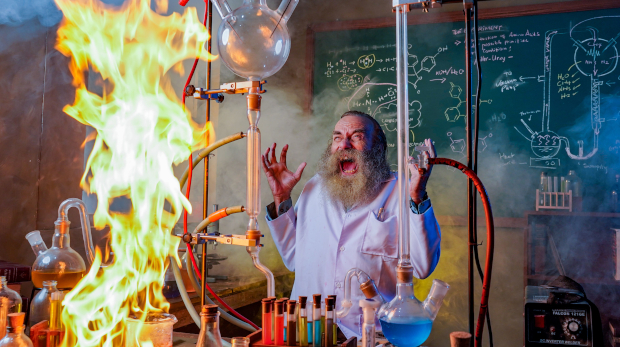
Grey goo! Frankenfoods! Killer bots! Throughout human history there has always been some kind of unnecessary and overblown existential panic that comes with any new technology.
In the 1940s, newspapers described the first electronic computers as ‘the controlled monster’, warning it could soon become ‘the monster in control’, reducing humanity to ‘degenerate serfs’ who would ‘perish, victims of their own brain products’*.
Alan Turing, who came up with the concept of the thinking machine, didn’t exactly help matters. In BBC radio talks, he mused that machines would “outstrip our feeble powers” and that “we should have to expect the machines to take control”. Then he laughed it off, comparing our fear of being superseded by artificial intelligence to the indignity of being outcompeted by a pig or a rat. He had a point. We’re still here. The pigs, poor souls, are still dinner table bound.

Grey goo arrived courtesy of nanotechnology pioneer Eric Drexler, who tossed off a two-paragraph thought experiment in his 1986 book about self-replicating nanomachines consuming the biosphere. By 2004 he was disowning the term entirely, saying he wished he’d never coined it, having watched it morph into a full-blown media event after the UK’s King Charles (who never actually said “grey goo”) asked the Royal Society to look into the nanotech threat. The Society duly investigated and concluded the whole scenario lay too far in the future to bother regulators. A Cambridge nanotechnology professor summed up the threat level at the time: “about as viable as time travel”.
Frankenfood has the best origin story of the lot. It wasn’t a scientist or an activist who coined it, it was a Boston College English professor called Paul Lewis, in a slightly cranky 1992 letter to The New York Times, suggesting it was “time to gather the villagers, light some torches and head to the castle”. That throwaway pun spawned a decade of ‘frankenfish’,’frankencorn’, and genuine EU trade disputes.
The London School of Economics’ George Gaskell later studied exactly how this happens. In a 1999 paper for Science, he wrote that the volume of media coverage, not the actual underlying risk, was what predicted public fear. As Gaskell put it, “at some point the metaphor becomes more than just an association. It becomes the thing”.
Which brings us to modern AI, and to Ireland, where, according to a PTSB survey published in December, 71% of respondents are worried about their jobs, up noticeably from the year before. Now, that is a reasonable concern. Automation of any kind always unfortunately leads to job loss, as the Luddites knew, but it doesn’t mean it’s flippin’ Skynet.
And, look, none of this means every warning is just empty theatre because the latest and loudest alarms are coming from AI’s own architects rather than outside moralists, which is a genuinely new development worth watching. But I think history’s pattern holds regardless: the scarier the coinage, the less anyone checks the maths behind it.
So here’s my prediction, offered with the full confidence of someone who has not developed ‘bicycle face’ as the Victorians thought women would (they even thought using a bike would cause them to go mad), nor have I lately been consumed by grey goo: in 30 years, someone will be writing a column about the Great AI Panic of the 2020s. The torches will have gone out. The villagers will have gone home. And the tomatoes, frankenfoods and all, will still be perfectly edible.
And if I’m wrong, I for one welcome our AI overlords.
*Although maybe this had finally panned out in 2026. Thanks AI slop.





 Ltd
Ltd