


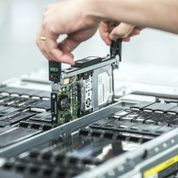
HP has launched a new class of server that is aimed at highly specific workloads and scale-out architectures. The HP Moonshot system consists of server cartridges that fit into a new blade-type chassis which the company claims delivers significant savings in terms of space, power consumption and cost.
The Moonshot 1500, a 4.3u server enclosure, is configured with 45 Intel Atom S1200 -based servers, one network switch and supporting components. HP claim that the new infrastructure uses up to 89% less energy, takes up 80% less space and costs 77% less compared to traditional servers.
The architecture is aimed at the kind of workloads that have emerged in recent years. In a video, CEO Meg Whitman said that to support the emerging needs of social, mobile, developing cloud and Big Data, data centres with an area equivalent to 20 football fields would be required drawing the same power as 20 million US homes if the industry were to persist with traditional architectures. This is unsustainable and so HP came up with an alternative approach to save on power, energy and space.
"With nearly 10 billion devices connected to the Internet and predictions for exponential growth, we’ve reached a point where the space, power and cost demands of traditional technology are no longer sustainable," said Whitman. "HP Moonshot marks the beginning of a new style of IT that will change the infrastructure economics and lay the foundation for the next 20 billion devices."

The new Moonshot system is the second-generation server from HP’s Project Moonshot. The new class of server is engineered to address the IT challenges created by social, cloud, mobile and big data. The Moonshot servers are built from chips more commonly found in smart phones and tablets, which allow the servers to deliver reduced energy use and a high-density footprint, all at a significantly lower cost. The new systems are also what HP is calling "software defined". What this means is that enterprises can optimise their servers based on specific workload needs.
The Moonshot system consists of the Moonshot 1500 enclosure and application-optimised ProLiant Moonshot servers. These servers will feature processors from multiple HP partners, each targeting a specific workload. The first systems are aimed at web hosting and static web delivery, with other systems envisaged for workloads not currently suited to commercial virtualisation.
David Donatelli, executive vice president and general manager of Enterprise Servers, Storage and Networking, Enterprise Business, HP said that due to the software-defined nature of the new server architecture, the cooperation of multiple partners and new volume economics, "future servers would be released at accelerated rates", up to three times faster than in the past.
"It is very clear that we need to do things differently-Moonshot is it," said Donatelli.
The new architecture separates the server hardware so that anything that is shared, such as power, cooling, etc, and incorporates them into the chassis. HP has "taken all the parts that are part of the server and shrunk them," said Paul Santeler, vice president and general manager, hyperscale business, HP.
This is "a modern architecture engineered for the new style of IT," said Santeler. The server "cartridges are designed for the specific needs of an application."
HP is working with a host of partners on the Moonshot programme, such as Intel, AMD, ARM, Texas Instruments and others.
With support for up to 1,800 servers per rack, Moonshot servers occupy one-eighth of the space required by traditional servers, said HP. Each chassis shares traditional components including the fabric, HP Integrated Lights-Out (iLo) management, power supply and cooling fans. These shared components reduce complexity as well as add to the reduction in energy use and space.
The Moonshot servers are scheduled to be released in second half of 2013 and are aimed at the emerging web, cloud and massive scale environments, as well as analytics and telecommunications. Future servers, said HP, will be delivered for big data, high-performance computing, gaming, financial services, genomics, facial recognition, video analysis and other applications.
TechCentral Reporters




Subscribers 0
Fans 0
Followers 0
Followers