


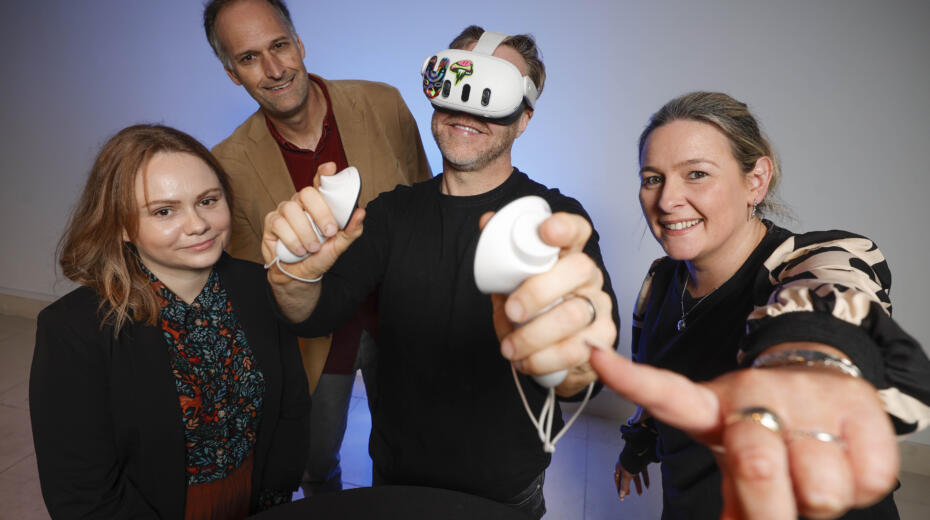
Four pilot projects receive backing from Smart Docklands to tackle local issues
A network of sensors along the River Liffey to deliver real-time data on water behaviour; immersive graffiti using augmented and virtual reality; a traffic management solution relying on data from citizen scientists; and a way to use Minecraft and open source data to map crowds were the winners of the first Smart Docklands Call for Pilots.
Smart Docklands, a partnership between Dublin City Council and the Connect Research Ireland centre for future networks headquartered at Trinity College Dublin, is one of the capital’s flagship smart districts where academia, industry and local government collaborate on and pilot community-centred technology innovations.
The Call for Pilots aimed to tackle key community priorities identified through a community survey that was carried out in late 2023 and early 2024 where insights were gathered from over 300 responses.

The four winners – River Liffey Water Sensors; Count Docklands; Craft my Street and HoloGen – each received seed funding of €12,500.
The winning pilots will tackle pressing challenges across environmental monitoring, community development, and antisocial behaviour, aiming to create a more sustainable, inclusive, and enjoyable Docklands for all.
Jamie Cudden, smart city lead, said: “These pilot projects highlight how technology can make a meaningful difference in people’s lives. By directly engaging with the community, we’ve chosen initiatives to address the Docklands’ community concerns around sustainability, youth engagement and environmental concerns. We are super excited to be working with such an amazing group of innovators and entrepreneurs who all want to make a difference for the Docklands community.”
The Smart Docklands programme established in 2017 and has a track record of collaboration where academia, local government, industry, and residents come together to address urban challenges through innovation and deployment of new and emerging technologies. The Call for Pilots is a testament to the programme’s commitment to ensuring that technology serves real community needs.
The Call for Pilots marked a milestone in creating a connected, innovative, and engaged urban environment. By addressing key challenges through collaboration, education, and smart technology, these pilot projects highlight the benefit of what smart districts can achieve.
“Engagement isn’t just for the sake of it – it’s about making real change happen. Thanks to the community survey we shaped our call for pilots around what really matters to the community: environmental monitoring, community development, and safety. It’s all about creating smarter solutions that are truly beneficial for everyone,” said Karolina Anielska, Smart Docklands project and engagement manager.
Smart Docklands was established in 2017 as test-bed for innovation and has delivered the following projects, including, but not limited to: connectivity experimentation including Dublin’s first 5G test-bed; Internet of Things devices such as Big Belly Bins, Ring Buoy Sensors and Gully Monitoring Sensors; engagement programmes including Academy of the Near Future for Youth and Local Authority Staff; and Innovation Tours, including the Smart Cities Urban Quest.
Olivia D’Arcy, chief operating officer, River Liffey Water Sensors, UTS Technologies, said: “Our pilot uses technology which will monitor flow rates, tidal height and water temperature at various recreational user points along the River Liffey. Supported by our App based monitoring system this enables the recreational users of the waterway to make better informed real-time decisions, whilst at the same time creating historical mapping and trending for use in profiling environmental changes along the Liffey. We are excited about the opportunity afforded to us by Smart Docklands Call for Pilots to share our smart city solutions with the users of the River Liffey.”
“Low-cost traffic sensors are an amazing opportunity for the Docklands area. They can measure more than just cars, they also count bikes and pedestrians. And they can be installed in locations that really matter to the local community,” said Dr. Anna Molter, Count Docklands, UCD.
“This call for pilots was a perfect opportunity for us to present our project’s potential on integrating children and young people in the discussion of complex issues related to their local communities,” said Dr. Ítalo de Sena, Craft My Street, UCD. “Additionally, it is an opportunity to validate our model and scale what has been developed so far to other projects and applications. With this pilot we expect to create a sense of ownership among children and young people by providing them a space to communicate their needs and view about their city in a playful way, while collaboratively creating a map of Dublin in Minecraft.”
Barry Haughey, artist and educator, Immersive Graffiti, HoloGen, said: “The Immersive Graffiti pilot is bringing the art of graffiti into the digital age, using VR to engage Docklands young people in schools and youth settings. This immersive project offers a creative platform to explore graffiti in a safe and innovative way, fostering self-expression and reimagining street art as a positive force. By connecting technology and creativity, the initiative aims to inspire new solutions for nurturing graffiti as a meaningful and celebrated art form.”
TechCentral Reporters


Subscribers 0
Fans 0
Followers 0
Followers