
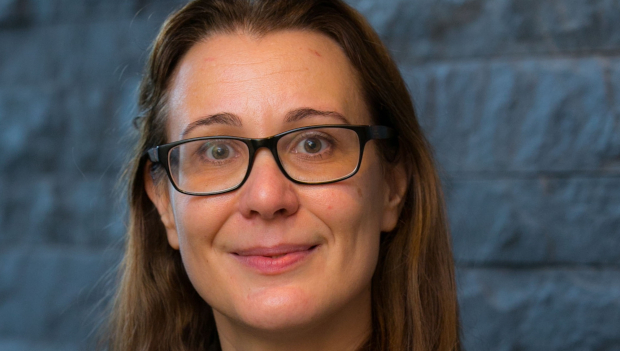
Focus on research: Dr Laura Brady, FutureNeuro
Dr Laura Brady is programme manager for BESTS, a patient-centric platform for clinical trial selection, based at the Science Foundation Ireland research centre for rare and neurological conditions, FutureNeuro. In this interview she talks about her experience of bringing together AI and blockchain.
Tell us about your academic background
I did my PhD in Trinity on neurodegenerative diseases such as Alzheimer’s Disease and Parkinson’s Disease. It was very lab-based. Following on from that I knew I didn’t want to go wholly down the academic route. I wanted to a role where there was real impact in terms of patient benefits, so I took on the role of head of research in Fighting Blindness – one of the largest research charities in Ireland. That opened a whole new world to me in terms of the lifecycle of research.
Working in Fighting Blindness showed me there’s a whole pathway to get from what happens in the lab to what becomes accessible to the patient. I could see the challenges facing clinical trials like finding patients and attracting trials to Ireland. It was and still is a real bottleneck in terms of getting access to beneficial interventions. I thought this was something I could really get involved in and it brought me back to the neurodegerative space, as well.
I’m currently managing and leading a consortium of partners including FutureNeuro, Microsoft and Akkure Genomics, to design and build and test this clinical trials matching platform that leverages AI, blockchain, and genomics.
This programme, BESTS, is supported through the Disruptive Technology Innovation Fund established under Project Ireland 2040. It’s a whole new space for me but one that can really accelerate and expedite that path to treatment for patients.
You’re using separate technologies that on their own would make for an interesting study. Was it a case of looking at the problem first or looking at what the technology might be able to do?
It was a little bit of the latter, using technologies like blockchain and AI to look at different problems. Looking at AI first, 80% of clinical trials fail to meet their enrolment target. For a consultant to refer a patient to a clinical trial often requires a time-consuming review of patient charts and information cross-checked against complicated eligibility criteria. At the same time patients don’t know how to access a clinical trial that meets their needs. We have used AI to take a different approach, placing the patient at the centre to make that process more efficient and effective.
For example, the Microsoft ‘trial matcher’ we use is an enterprise-grade model and this AI tool has been enhanced by Akkure Genomics, which is a digital health start-up. Here the patient drives this whole process. They decide what data to share with BESTS, whether it be genomic or clinical, and populate a profile in collaboration with their healthcare professional. Then an AI algorithm interprets that data and matches it against eligibility criteria of online clinical trial databases. It pulls a list of trials that matches the patient’s gender, age, condition, location, then it uses natural language processing and extracts eligibility information from that section producing a personalised list. This can take minutes in comparison to the manual review of charts by the healtchare professional.
With blockchain we’re addressing the challenge of patient privacy. We are using blockchain to store a patient’s consent. We do this via a smart contract containing what the patient has consented to, what data they have consented to sharing, but also a log of if they have changed that consent at any time. The nature of the distributed database means that this information is stored securely, it’s immutable, hamper-proof, and fully traceable.
We’ve been very cognisant during the prototyping of BESTS is to look at AI and blockchain from an ethical perspective, asking what we need to embed in the design to alleviate any concerns. That’s something we’ve really taken the time to research, review, work with our partners and implement amendments into the design, so we have a tool that is trustworthy and transparent.
There are plenty of ways to recruit for studies from getting student volunteers to citizen science. Do you think the anonymisation of patient data will help attract more people?
Yes and there’s a number of things we can do to build that trust and confidence and that’s by being fully transparent. In the BESTS platform we have an FAQ where we explain exactly what the AI is doing, how it works and its limitations, and we do the same for blockchain. The participant that is sharing their data gets to see the exact same information as their consultant and all the trial matches. They’re driving this whole process which gives that participant even more confidence in that if they want to withdraw they can easily withdraw.
The first target for the BESTS platform is people who are already looking to participate in clinical trials, that are already engaged in research that are looking for alternatives. This cohort, especially in the rare disease community, are much more open to sharing data if it means they can potentially access a clinical trial or even contribute to research that benefits others. They would be our initial target audience. This is where we have taken a co-design approach, capturing the concerns that are out there, trying to understand their needs and expectations and identifying how the platform can add value to them. That’s not always done in building digital health technologies.
We’ve seen an explosion of tools since Covid but they aren’t being used as much as they could. One of the reasons why is the lack of attention to the user perspective. We often see patients brought in at the the usability and utility stage but at that point the ability to influence design is quite limited. We’ve taken a more dynamic approach to get the user perspective from the very beginning. Hopefully that will help people feel more confident in using this technology.
Do you see BESTS having widespread application or staying within the rare disease community?
We designed it around and validated it in epilepsy but the idea is this will be used in any condition. When we were doing our initial requirements gathering we met people living with a whole range of conditions sowe could understand how BESTS could add value to them. It was really important to us not to just have people with neurological diseases but all other conditions included because we do see this as being relevant to any condition and any patient cohort.
Are there any other developments you see that would add value to BESTS?
In AI, blockchain, genonimcs and cloud computing we have so much already. The important thing is to look at the evolving digital health landscape and see what actually is coming down the track, such as emerging regulations.
For the first time we have an AI Act and that might have implications for technology like BESTS. It’s something we;re going to be continually monitoring and assessing. It’s a very exciting phase in balancing the number of digital technologies we have to ensure we build a tool that’s accessible to all.




Subscribers 0
Fans 0
Followers 0
Followers