



What the cloud services people have done, McEwan explains, is to go for standardised commodity hardware. “But then the management tools have been developed to be largely autonomic, simple, API-driven with minimal human intervention. That is where I think you will see large enterprises and Tier 2 service providers identifying the benefits for them and selectively adopting what suits. We won’t see anything like a Big Bang approach, but we are already seeing the move towards software-defined everything on commodity hardware.”
IoT effect
Interestingly, McEwan instances the Internet of Things as another post-cloud area in which web scale ICT will not only grow but be essential. “We are going to need some new mechanisms for interpreting how they all connect together and what benefits can be derived from the collection and analysis of massive amounts of data. Once again for speed and efficiency we have to be talking about API-driven, standardised and task-oriented systems.” He points out also that we are having to move towards a new type of operating system. Today’s OS is focussed heavily on storage addressing and management. But we are also trying to get the compute and storage elements closer together in every sense — and there is no question that non-volatile and cheap solid state storage is going to be essential for performance. So web scale IT faces challenges at that OS level. In fact across web services only about 10% of the data is hot at any time — and it cools rapidly — so how do you handle that, how do you manage data migration between the tiers while delivering the performance that is demanded by web scale IT?”
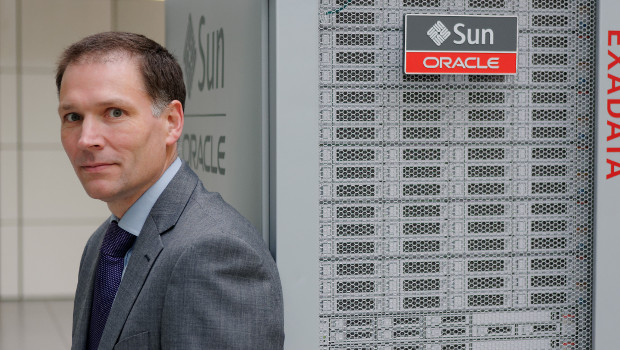
Oracle’s John Abel raises the market reality question: “Most of my potential enterprise clients are still asking something like ‘What is cloud?’ so enquiring about their web scale IT strategy is not likely to produce instant enthusiasm.” As senior business director for Oracle Engineered Systems in EMEA, however, he sees a clear continuum starting to show. “Cloud is not going to stop. But it is going to evolve, as it already has, and become something slightly different. I think what Gartner has identified is that from now on everything in business and ICT is going to be about how fast you can change. Remember when we used to talk and think about IT projects in terms of several years? Now it’s perhaps months and very soon it will be days or even minutes.”

Potentially infinite
“The most successful enterprises clearly have the ICT capability to evolve depending on what the business wants to do,” Abel said. “That in turn depends on its customers. Once upon a time we knew them, knew their patterns and habits. Now the in the digital world customers are unknown, the number of likely customers is unknown. Yet amidst those unknowns, scaling and business growth is dependent on what the business can provide. With physical goods there are production and transport constraints. But in digital services my capacity to meet demand is potentially infinite. If you look at what web scale provides today you could align it with SaaS and the provision of multiple consistently satisfactory user experiences.”




 Ltd
Ltd