


The AI boom’s infrastructure problem: servers are not cables
Alphabet just reported $100 billion (approx. €86 billionn) in quarterly revenue. Meta’s share price bounced 10% after announcing plans to double down on AI. And yet a question is beginning to surface: have we built too many data centres?
Magical as it may seem to some, the reality is that AI is no more mystical than any other technology and the chatbots writing our e-mails so that we don’t have to (and reading them, also so that we don’t have to) are only the tip of the metaphorical iceberg. The real story is not one of this versus that language model, but serious spending on tin. After all, those tasty Nvidia GPUs all have to go somewhere, but whether all of the infrastructure spending will pay off is another matter entirely.
Predictions are a mug’s game, but despite the huge sums being invested, or perhaps because of them, some attention is being paid. In March 2025, Joe Tsai, the chair of Alibaba, said he was seeing “the beginning of some kind of bubble”. In addition, MIT research showed 95% of organisations getting zero return from generative AI pilots, while the Uptime Institute says many announced data centres “will never be built, or will be built and populated only partially”. Just this week, a new Deloitte survey of thousands of managers worldwide shows poor success in actually getting trials of AI into production.

None of this is entirely without precedent, of course. Indeed, a previous round of super-spending left behind chunks of metal and banknotes reduced to cinders: the 2001 dotcom crash.
When speaking of 2001 it needs to be borne in mind that the most visible casualties, the likes of Pets.com, were not really the issue. Yes, every website that glued on an e-commerce facility was rewarded with a lofty valuation that turned to dust when the market crumbled, but these headline-grabbing failures obscure more than they illuminate. Real money was lost, yes, but the e-commerce boom and bust was headline-worthy for two reasons. Firstly, it was entirely predictable and, secondly, and consequently, it was funny. Anyone who genuinely thought flogging cat litter on the Internet was the future of technology needed an appointment with reality.
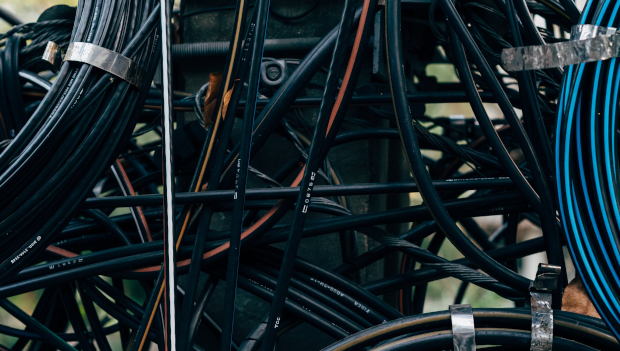
The real cost – and benefit, but we’ll come to that – of the dotcom escapade was infrastructure spending. The dotcom bust was, in fact, a telecommunications bust.
Following the Telecoms Act in 1996, US telcos spent hundreds of billions upgrading their networks: local copper, fibre, and the subsea cables that bring continents together. As the public Internet grew, their counterparts in Europe and Asia followed suit. When the crash came it was painful, and a lot more significant than a few websites shutting down: in the US alone, shareholders lost roughly $2 trillion (approx. €1.7 trillion) in value, half a million workers lost their jobs, and a wave of bankruptcies followed.
More than 20 years into the future all of that spending has come in handy: the world is simply more connected than it was and the data flows tell us that the newly-built capacity did not go to waste. The spending that created it did take a very long time to amortise, though.
If a similar scenario plays out with data centres, it might be rather different, and not in a good way.
The upshot of data centre spending driven by AI would indeed be excess capacity for future growth. But what would we do with it? It is true that demand for storage and computation is near limitless, but near limitless is not the same as without any limits whatsoever. In a context where data is viewed as at least a potential goldmine, anything that can be computed will be computed. If that turns out to only be true when investors have lost the run of themselves, though, a very different picture will be painted.
Hard figures are, of course, elusive, but data compiled by Statista suggests there are more than 4,000 dedicated data centres in the US and at least 2,250 scattered across the EU. Morgan Stanley estimates that global spending on these facilities will reach nearly $3 trillion (approx. €2.6 trillion) by 2028, with roughly half financed through private credit rather than Big Tech’s own balance sheets.
Excess cable capacity is passive and patient: under-used cables can be allowed to sit there until demand catches up. Data centres are a rather different proposition: they are active, expensive to run, and filled with hardware that depreciates rapidly. As a result, if AI demand doesn’t materialise at the scale investors are betting on, the end result is not businesses being left with a useful asset waiting for its moment so much as it would be warehouses of servers burning electricity and losing value.
Telecom infrastructure enabled connectivity, which turned out to be near-universally valuable. Data centre capacity enables computation, which is only valuable if someone actually wants to compute something.
Computation costs are already low, a major factor in the cloud computing boom, but a race to the bottom would not necessarily result in a data bonanza. After all, if the graph isn’t going up and to the right, then why even bother? The telecom crash, for all its pain, left behind the series of tubes through which the modern Internet flows. A data centre correction would leave behind posh sheds, scrap metal and electricity bills.




Subscribers 0
Fans 0
Followers 0
Followers