


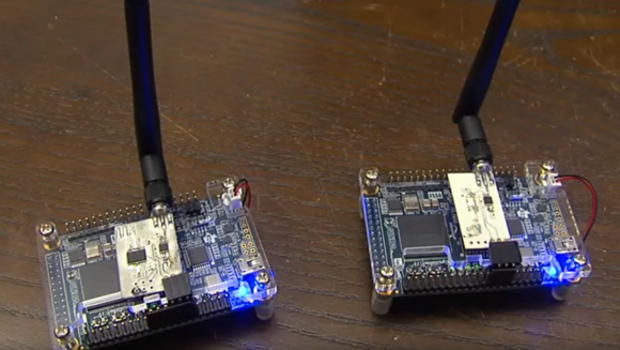
By now, the power hogs on your smartphone and PC are well known: the display, the CPU, and the need to power up your Wi-Fi or 3G radio to send and receive data, all consume power and chip away at your battery life. But researchers have found a way to almost eliminate the power consumed by Wi-Fi, although you’ll need some new chips inside your router and your smartphone.
What researchers at the University of Washington are calling passive Wi-Fi slashes the power used by 802.11b transmissions to just 59 microwatts, or about 10,000 times less than a conventional Wi-Fi chip would consume. A spin-off, Jeeva Wireless, has been formed with the intention of commercialising the so-called backscatter technology, the university said.
Here’s how it works: Imagine Wi-Fi as a torch beaming data back and forth. Your router has a torch pointed at your phone, and your phone has one as well. Passive Wi-Fi eliminates one of these torches and replaces it with a mirror. Your router still uses its existing Wi-Fi signal to send data to your device; it’s just that the passive Wi-Fi technology simply reflects it back. The stream of reflected, backscattered off and on signals transmits the data at up to 802.11b speeds, or 11Mb/s. Researchers say that they’ve been able to transmit this data between 30 and 100 feet, using both line-of-sight and through-wall scenarios.

It’s possible that this could have a significant impact on how your phone sends and receives data. Unfortunately, it will probably require new hardware, both routers and mobile devices. But there’s another scenario: passive Wi-Fi could emerge as an ultra-low-power alternative to Bluetooth, whose Low Energy derivative consumes power in the hundredths of watts, rather than the millionths of watts that passive Wi-Fi requires. That could make it an ideal solution for the Internet of Things.
The nitty-gritty
Passive Wi-Fi works on a few assumptions, one of the more important being that the analogue and digital portions of the the wireless radio have become increasingly decoupled.
Passively listening for a digital signal doesn’t take much power, relatively speaking; it’s the analogue broadcasting of a response signal that consumes most of it. Simply reflecting the signal eliminates the vast majority of this power.
But something has to generate the transmission power – and in this case, it’s a plugged-in device like a router. A router would require some form of a transceiver that could broadcast a wireless tone on a frequency that wouldn’t interfere with the existing Wi-Fi channel. The passive Wi-Fi chip could then reflect that tone back at the receiver. But the researchers also said that the technical process of backscattering that information at a given frequency would also bring that tone back into the frequency range used by the Wi-Fi channel – allowing the router or receiver to make sense of it all.
The problem is that a passive Wi-Fi system also means that the passive sensor can’t call for attention, or signal the router that it’s ready to transmit data. Instead, routers will have to order the passive Wi-Fi device to send data at a given time. That’s not a big deal, although the latency might be a bit higher than normal.
In any event, the promise of passive Wi-Fi is still a couple of years off. But it’s a possible future that looks more and more intriguing as we use our mobile devices ever more frequently.
IDG News Service



 Ltd
Ltd