


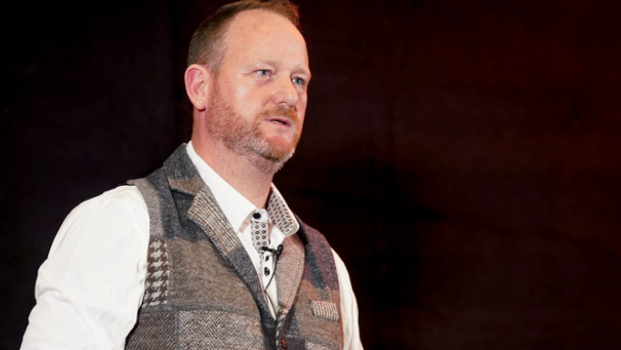
Stephen Conway received the award for IT professional of the year at the 2026 Tech Excellence Awards. In this conversation with Deirdre McArdle he talks about the importance of innovation, his experience as an author and how IT service management maintains a low profile in most organisations.
It was your first time winning a Tech Excellence award, specifically IT professional of the year. What did the win mean to you?
It was huge. On a personal level, it was recognition of a career spanning almost 30 years in technology. But what made it particularly meaningful was the recognition it gave to IT service management (ITSM).
ITSM is often working quietly behind the scenes, keeping services running, managing change and helping organisations navigate incidents and transformation. It rarely finds itself centre stage.
Since the award, I’ve had people from across the ITSM community reach out to say how positive it was to see the profession recognised in this way. That means a great deal to me. I may have received the award, but I see it as recognition of the discipline and the many people who work in ITSM every day.
You have become increasingly involved in speaking and thought leadership. Why is that important to you?
I think we have an opportunity to change the conversation around IT service management and technology resilience.
ITSM is sometimes perceived as being about tickets, processes, service-level agreements (SLAs) and governance. Those things matter, but they are only part of the story. At its best, ITSM is about creating confidence in technology and connecting people, technology and business outcomes.
That thinking was also behind my book, Under the Dashboard: A Real Life in ITSM. I wanted to talk about the reality of working in ITSM, the people behind the processes, and the experiences you simply don’t see in a dashboard or monthly report.
That same message now carries through into my masterclasses, speaking engagements and wider thought leadership. I want people to see ITSM not simply as an operational discipline, but as something that can actively enable transformation.
Technology will continue to change. Good service management provides the foundation that allows organisations and, importantly, their people to embrace that change with confidence.
Technology is changing incredibly quickly. Where do you see ITSM fitting into that transformation?
Technology transformation is rarely limited by the technology itself.
We have cloud, AI, automation, analytics and an extraordinary range of platforms available to us. The harder questions are how you introduce those technologies safely, how you support them, how you manage change and risk, and ultimately how you make sure they deliver value to people. That is where mature ITSM becomes incredibly powerful.
The principles behind service management give organisations a framework for embracing new technology without losing control of the fundamentals: service ownership, change, resilience, support, governance and continual improvement.
My view is simple: transformation without service management can become technology deployment. Transformation with strong service management has a much better chance of becoming lasting business change.
AI is dominating the technology conversation. How do you think organisations should approach it?
AI is genuinely transformational, but the excitement around it shouldn’t make us abandon the disciplines we’ve learned over decades of technology change.
I’ve worked through multiple generations of technology, operating systems, cloud, new ways of working and different delivery methodologies. The technology changes, but many of the questions remain remarkably consistent.
Who owns it? What service does it support? What happens when it fails? How do we manage change? What are the risks? How do we measure whether it is actually delivering value?
That’s why I think service management has an important role in the AI conversation.
The objective shouldn’t be to use governance to slow innovation down. Good governance should give organisations the confidence to move faster because they understand the risks, controls, ownership and expected outcomes.
AI may be disruptive technology, but it still has to become a reliable service.
Regulation and operational resilience are increasingly important. Does that change the role of ITSM?
Absolutely. Frameworks and standards such as DORA and ISO 27001 reinforce many principles that strong service management has advocated for years: understanding your services, knowing your dependencies, managing incidents effectively, controlling change and continually improving resilience.
I don’t think compliance should simply be treated as an audit exercise.
The real opportunity is to take those requirements and translate them into sustainable operational practices. When governance is properly embedded into how technology teams operate, compliance becomes much more of an outcome of good management rather than an activity performed purely in preparation for an audit.
For me, that’s another reason ITSM deserves a stronger voice at leadership level.
You talk a lot about human-centred technology leadership. What does that mean to you?
Technology transformation ultimately succeeds or fails with people. You can implement the best platform, automation or AI capability available, but if people don’t understand it, trust it or see how it helps them, then the transformation hasn’t really succeeded. That’s why I believe technology leadership needs to remain human-centred.
ITSM sits at that intersection between people, technology and the organisation. We see technology from the user’s perspective, the operational perspective and the business perspective.
Processes and tools are important, but listening, communicating and understanding the experience of the people consuming the service are just as important. Ultimately, technology should make people’s working lives better, not simply make the technology estate more sophisticated.
Has winning the Tech Excellence award changed what you want to do next?
If anything, it has given me a bigger platform to talk about something I’ve believed in for a long time.
Writing Under the Dashboard: A Real Life in ITSM was part of that journey. The book was an opportunity to share the human side of a career in ITSM and some of the realities behind the processes, metrics and dashboards we work with every day.
The Tech Excellence award, followed by the opportunity to deliver masterclasses and take part in wider industry conversations, has encouraged me to take that message further.
I want to keep challenging some of the traditional perceptions of ITSM. Service management doesn’t need to sit quietly behind the technology organisation. It has a genuine role to play in conversations about AI, transformation, resilience and technology leadership.
If the award, the book and the speaking opportunities give me a platform to help move that conversation forward, then that’s something I’m incredibly proud of.


 Ltd