



With many new technologies often the most challenging aspect is properly expressing the value for the customer. Big Data, analytics and business intelligence is just such an area where the possibilities are so vast that it is often hard to crystallise the solutions into firm examples that are accessible for all.
Motorsport is increasingly seeing the application of technology in the pursuit of performance and the vast amounts of data available are perfect fodder for analytics and visualisation, with the potential to answer questions that have previously been unasked.
John McGuinness is an international motorcycle racer with a record of success over a 25-year career that is almost unique. However, even this endurance racing legend and 23-time Isle of Man TT winner has questions as to how he performs as he does.
“For 25 years I’ve known I was fast. Fast in the corners; even faster on the straights. 200 miles an hour. What happens to my body at that speed? My brain? My reactions? Where any mistake could be my last. Yeah, I’ve always known I was fast — but I’ve never known why — until now,” said McGuinness.

TT legend John McGuinness, right, takes in the data with analysts and crew (Image: EMC)
EMC, in partnership with motorcycle protective equipment company Alpinestars and Freescale Semiconductor, put together a project that was designed to measure every aspect of McGuinness’ performance to see why he was able to perform at such a high level, consistently and often against much younger competitors. The data sets gathered would then form the basis of an international competition to encourage the use of analytics and visualisations in new and innovative ways.
At the Circuit Monteblanco in Spain, a team of technicians, specialists and IT experts deployed a suite of sensors on a super-stock specification Honda CBR1000RR Fireblade, and an Alpinestars’s race suit for both McGuinness and motorcycle journalist Adam Child. Child was to be the control as a fast, skilled non-racer to McGuinness’ race pro experience. Both riders then lapped the circuit to provide base data for analysis. As well as measurements from the bikes for the likes of suspension travel, engine revs, power and lean angle, there was also heart rate, body positon, energy input to control surfaces and more, to provide a deep understanding of both machine performance and rider interaction.
“This is the first time in motorcycle history anyone has gathered data from man, machine and the environment — and in the harshest of conditions — to uncover the secret behind what makes one unique rider the fastest man on two wheels. It’s proven to be a monumental big data challenge and the insights we’ve uncovered thus far are fascinating,” said Michael Foley, director, Marketing Science Lab, EMC.
“The data showed, from the test we did in Spain,” said Child, “how relaxed he is. He’s very relaxed, he’s very smooth and he lets the bike do all the work for him. He’s using all the revs, all the power with the correct gears.”
However, as Bharat Badrinath, project lead for EMC, points out, this was near lab conditions and wholly different to a race. With the base data in hand and the equipment working well, the project headed for the white heat of the 2015 Isle of Man TT race, where McGuinness was racing his Honda in the Superstock class against some of the top road racing competitors in the world on the longest and possibly the most dangerous circuit in the world.
Speaking to TechPro, McGuinness said that despite being used to seeing bike performance data throughout his career, the extra dimensions in this project provided more insights.
“I could see where I was getting stressed, coming up to the bits I didn’t like,” said McGuinness.
Despite a career spent winning around the island, McGuiness said that there were still sections of the 60km lap that were of more concern than others. In certain sections, such as Parliament Square, said McGuinness, I could see my heart rate goes up, I’m breathing heavily and tensing up on the bike.
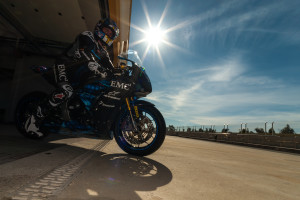
Rolling out for another session with a fully instrumented bike and suit. (Image: EMC)
McGuinness said that by knowing that he was involuntarily tensing up, he knew where he needed to concentrate on remaining relaxed to achieve his characteristic fluid speed.
He said there were four or five areas of the track where the data showed he could gain a second or more by simply concentrating on not tensing up. Even on a 60km lap, he said, that is a significant advantage.
This exercise in measuring more to learn more can be applied outside of racing too, said McGuinness. Road riders can benefit too, as the integration of technologies between bike and rider can allow sensors in protective gear to measure rider parameters to warn against fatigue, dehydration, course deviation and more, making motorcycle riding safer.
The experience gained is already being integrated in offerings from Alpinestars and can also be applied to other areas such snowboarding, skiing, and other sports.
“They found things for me that keeps it interesting,” said McGuinness.
The EMC project created data sets that were used as the basis of an international competition for analysts to see what insights and visualisations could be derived from the data. Prizes were awarded in modelling and visualisation categories to encourage the development of skills and insights in this growing area of value for enterprise.
TechCentral Reporters




Subscribers 0
Fans 0
Followers 0
Followers